
New Starbucks in China stands wall to wall with building seized from Uyghur family over terrorism charge
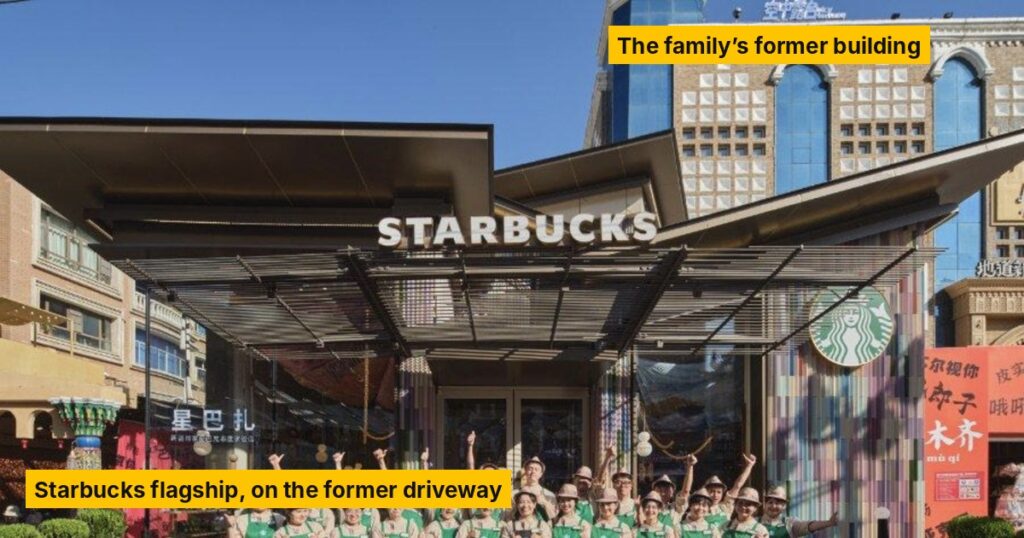
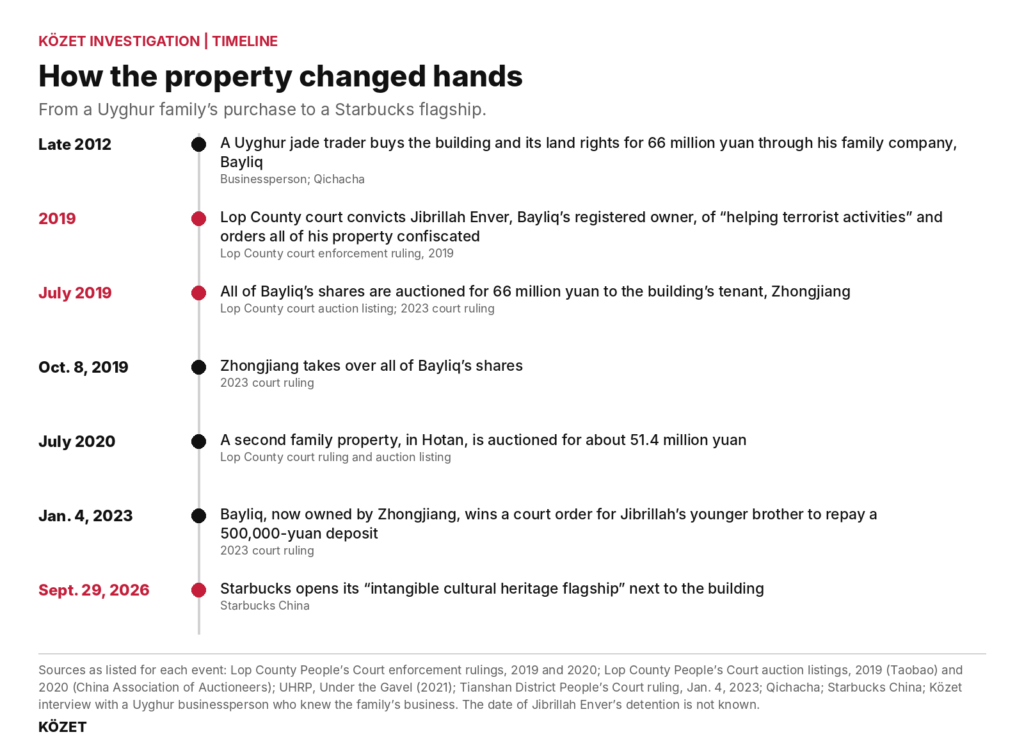
A Chinese court auctioned the family’s company, which owned the building and its front and rear parking lots, to the building’s tenant in 2019. Seven years later, Starbucks opened a flagship, built in cooperation with local state-owned capital,, on the former driveway to the rear lot.
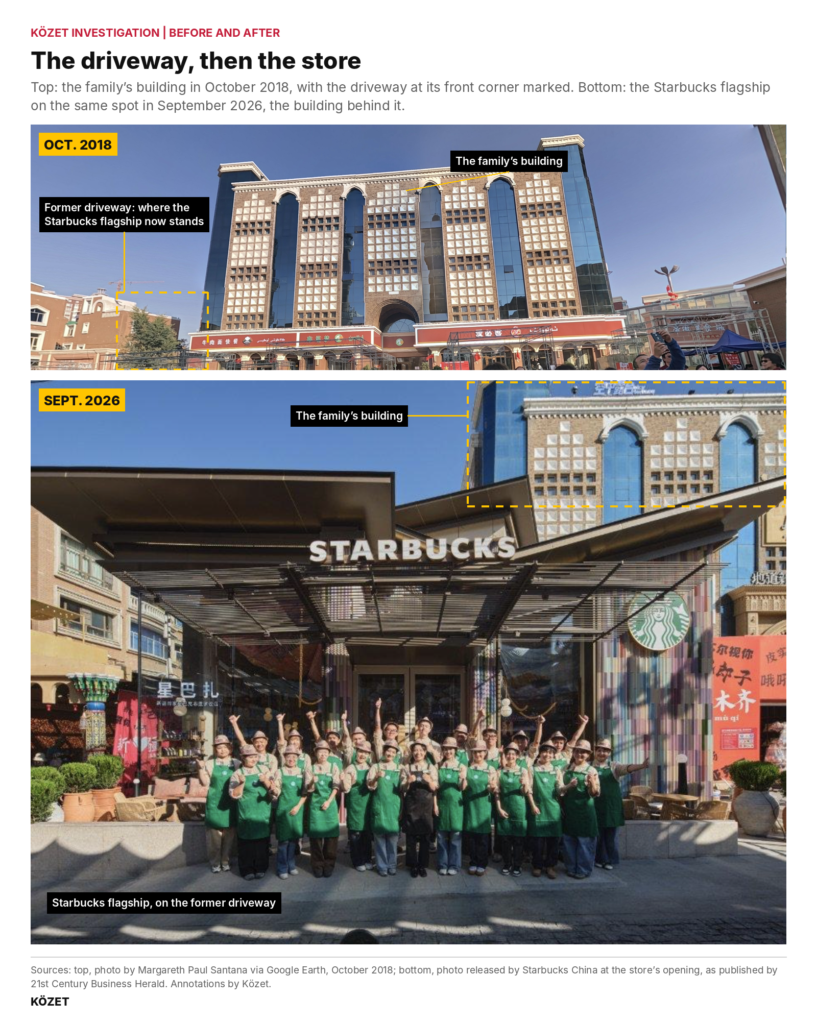
NEW YORK (Közet) – Starbucks’ new flagship in Urumqi, the capital of the Xinjiang Uyghur Autonomous Region in northwest China, opened on Sept. 29 dressed in Uyghur silk and music. It stands wall to wall with a building that a Uyghur family lost when a Chinese court seized their company. Satellite images and visitors’ videos show the store was built on the building’s former driveway.
The family’s loss is recorded in a lawsuit. In January 2023, a court in Urumqi ordered a young Uyghur man to repay 500,000 yuan, about $72,000, to the company his family had once owned. He had collected the money, paid by the company’s tenant, in 2018, when the business was still the family’s.
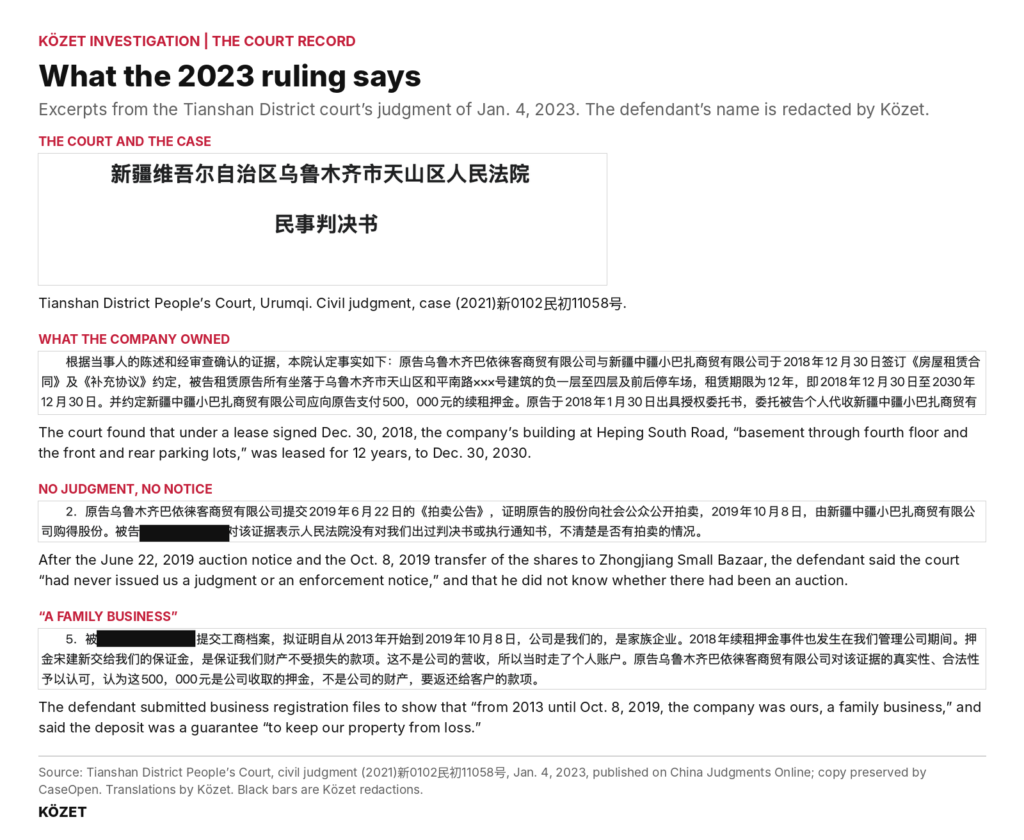
In court, he said the company “was ours, a family business,” and that no court had ever issued the family a judgment or an enforcement notice. He did not know, he said, whether there had been an auction.
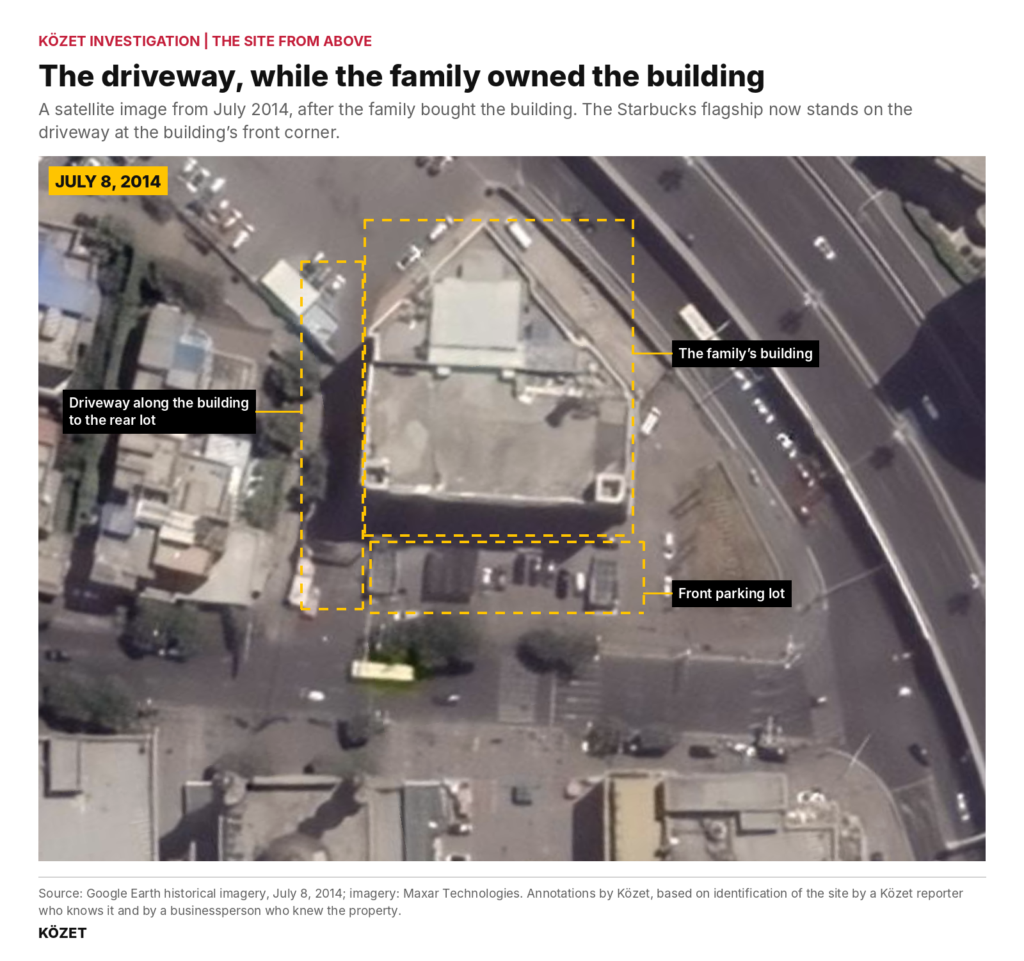
“The driveway and all the parking lots in front of and behind the building were part of the family company’s property,” said a Uyghur businessperson from the region who now lives outside China. “With the driveway to the lots, the property covered about 10 mu [roughly 1.6 acres],” the businessperson said, adding: “China illegally grabbed that land.” The businessperson has known the family’s business for years, knew the details of how it was run and asked not to be named for fear of reprisal by the Chinese government.
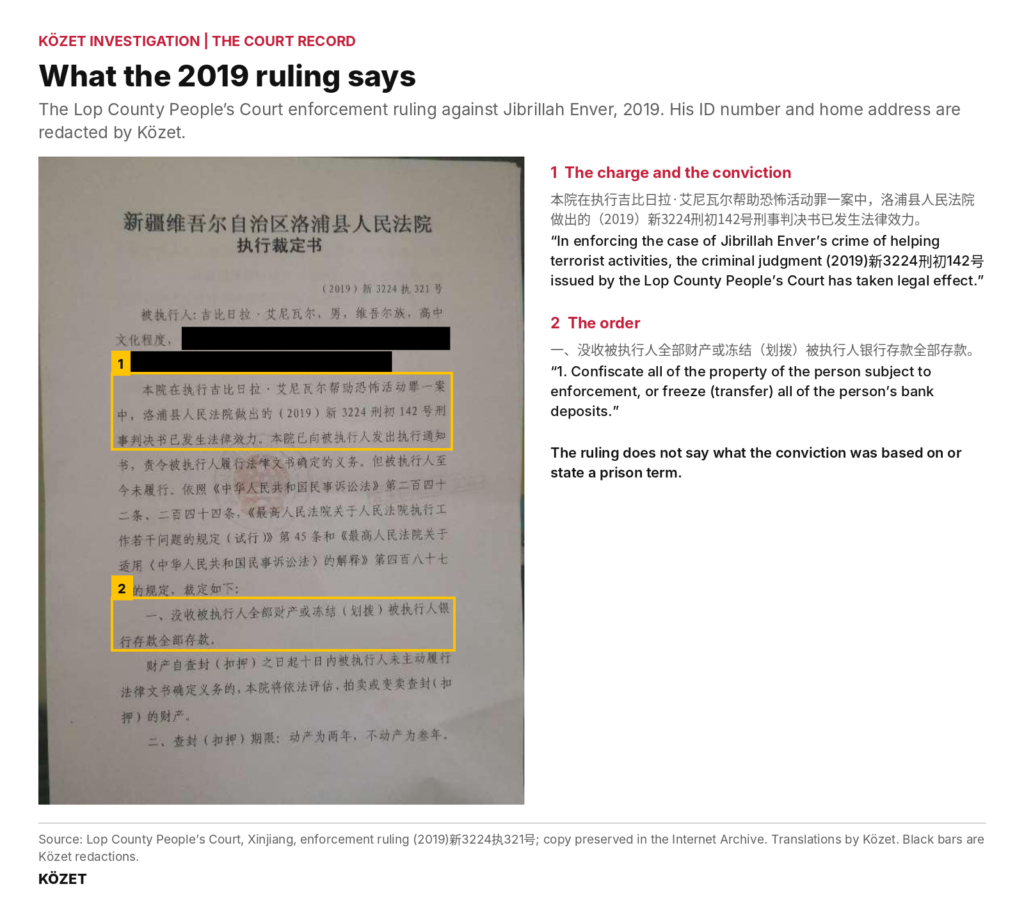
The seizure began in 2019, when a court in Lop County, in Hotan prefecture about 600 miles southwest of Urumqi, convicted Jibrillah Enver, whom the businessperson identified as the young man’s older brother, of “helping terrorist activities” and ordered all of his property confiscated, according to the court’s 2019 enforcement ruling.
The businessperson said Jibrillah was convicted for sending less than 100,000 yuan, about $14,000, to his father, who was living abroad, and was sentenced to 10 years in prison. The court’s rulings do not say what the conviction was based on or state a prison term, and Közet could not independently confirm either account.
Under Article 120-1 of China’s Criminal Law, the crime of helping terrorist activities covers funding terrorist organizations, people who carry out terrorist activities or terrorist training. In serious cases, it carries five years or more in prison and a fine or the confiscation of property.
The charge against Jibrillah “was unfounded,” the source said, “and served as an excuse to strip the family of its wealth, as the Chinese [authorities] did to many other Uyghur business families in the past decade.”
The conviction came during a campaign in which more than 1 million people in the region were detained, in internment camps and in prisons, the U.S. government and researchers estimate. China has called the camps vocational training centers meant to counter extremism, says it is fighting terrorism and denies abuses.
The United Nations human rights office found in 2022 that China’s anti-terrorism laws are “based on vague and broad concepts” and “vulnerable to arbitrary and discriminatory application.” Leaked government records from Karakax County, also in Hotan prefecture, listed reasons for sending residents to detention camps that included having “relatives abroad,” The Associated Press reported in 2020.
Among the property seized was the family’s company in Urumqi. It owned a building on Heping South Road and the building’s front and rear parking lots, and leased the basement through fourth floor and both lots to a tenant, the Xinjiang Zhongjiang Small Bazaar Trading Company (新疆中疆小巴扎商贸有限公司), according to a 2023 court ruling.
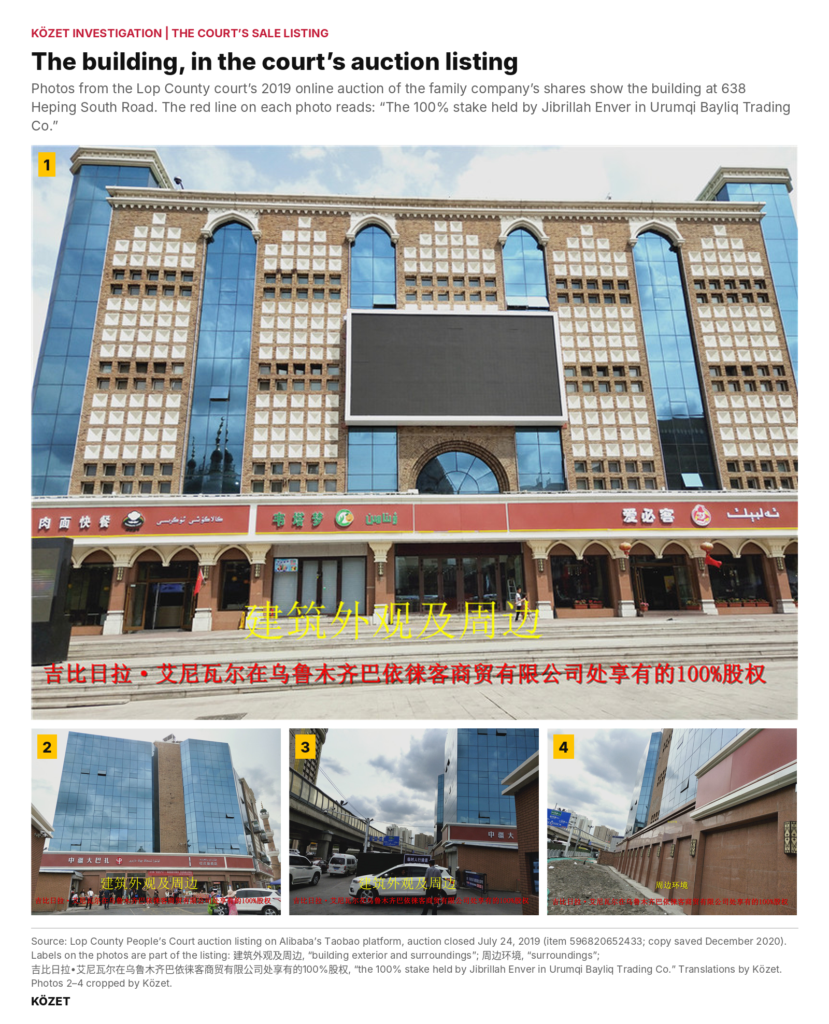
An auction notice dated June 22, 2019, put all the company’s shares up for sale in an online court auction on Alibaba’s Taobao platform. The tenant placed the only bid, at the starting price of 66 million yuan, about $9.6 million at the time, and won on July 24, according to the Lop County court’s auction listing.
When the family bought the building in 2012, a business run by Song Jianxin was already renting it, according to the businessperson. In January 2018, Song was the legal representative of the tenant, Zhongjiang, according to the 2023 court ruling.
The family had paid the same 66 million yuan for the building and the rights to its land in late 2012, the businessperson said. In or around 2014, “the family received offers of about twice what it had paid, but chose to keep the property.”
Hotan, in the south of the region on the edge of the Taklamakan Desert, has been a center of the jade trade for centuries. Jibrillah’s father, a jade trader from Hotan who later also became a real estate developer, made the purchase, according to the businessperson. He bought the building through a company, the Urumqi Bayliq (or Bayilaike in Chinese) Trading Company, 乌鲁木齐巴依徕客商贸有限公司, which was registered in August 2012, according to Qichacha, a Chinese corporate database, and the court’s auction listing.
The father registered the company under his eldest son, Jibrillah, who was born in 1995, the businessperson said; the ID number recorded in the 2019 court ruling shows the same birth year. The Lop County court’s auction listing names Jibrillah as the company’s legal representative and shows that he took a 100% stake in April 2013. The 2023 ruling records that the young man’s mother chaired the company.
Starbucks did not answer questions about who owns its building or the land beneath it, or whether anyone checked the property’s history before the store was built. Before publication, Közet put its findings about the property to Starbucks and to Boyu Capital, the Chinese private equity firm that took control of Starbucks’ China business in April. Neither responded, and the Chinese Embassy in Washington did not answer Közet’s questions.
Two auctions
When the Uyghur Human Rights Project (UHRP), a Washington-based research and advocacy group, published a report in September 2021 that included Jibrillah’s case, The Wall Street Journal reported that since 2019, courts in the region had put at least 150 assets, belonging to at least 21 people and valued at a total of $84.8 million, up for auction on e-commerce sites.
Zhongjiang, the building’s tenant and the winner of the July auction, took over all the shares of Bayliq, the family’s company, on Oct. 8, 2019, according to the 2023 ruling.
The court’s listing described what was for sale: the building, with 6,515 square meters of floor space from the basement through the fourth floor, and a parking lot at 424 Heping South Road, on 6,318.75 square meters of land, about 9.5 mu or 1.6 acres, close to the businessperson’s estimate. An appraisal for the court valued the company at 60.8 million yuan, about $8.8 million.
In June 2020, the same court ordered the auction of industrial land-use rights and buildings in Hotan that it said Jibrillah actually owned, although they were registered under another person’s name, whom the businessperson identified as a family member. They sold that July to a hospital company for 51.4 million yuan, about $7.3 million at the time, according to the court’s auction listing. As in Urumqi, only one bid was placed, at the starting price.
The proceeds of both auctions went to the Chinese government through the court, the businessperson said. As far as the source knew, the family had no bank loans and no liens on its properties in Urumqi or Hotan that the money would have paid off. The court’s listing showed the Urumqi company had no loans; its only debt was 5,500 yuan, about $800, in unpaid wages.
After the auction
By 2021, Wang Hua was chairman and legal representative of Bayliq, the family’s former company, according to the 2023 ruling, and the company sued Jibrillah’s younger brother at the Tianshan District People’s Court in Urumqi. The brother told the court that he was 17 when he collected the 500,000 yuan, a rent deposit, in cash. The company produced a letter, dated Jan. 30, 2018, authorizing him to collect the money; he said he had never seen it. The money, he said, was a guarantee the tenant had paid the family to protect its property from loss, not company income. He said he had passed it to his mother, who chaired the company at the time. The court said he had no evidence to prove it and ordered him to repay the money with about 61,000 yuan, about $8,800, in interest.
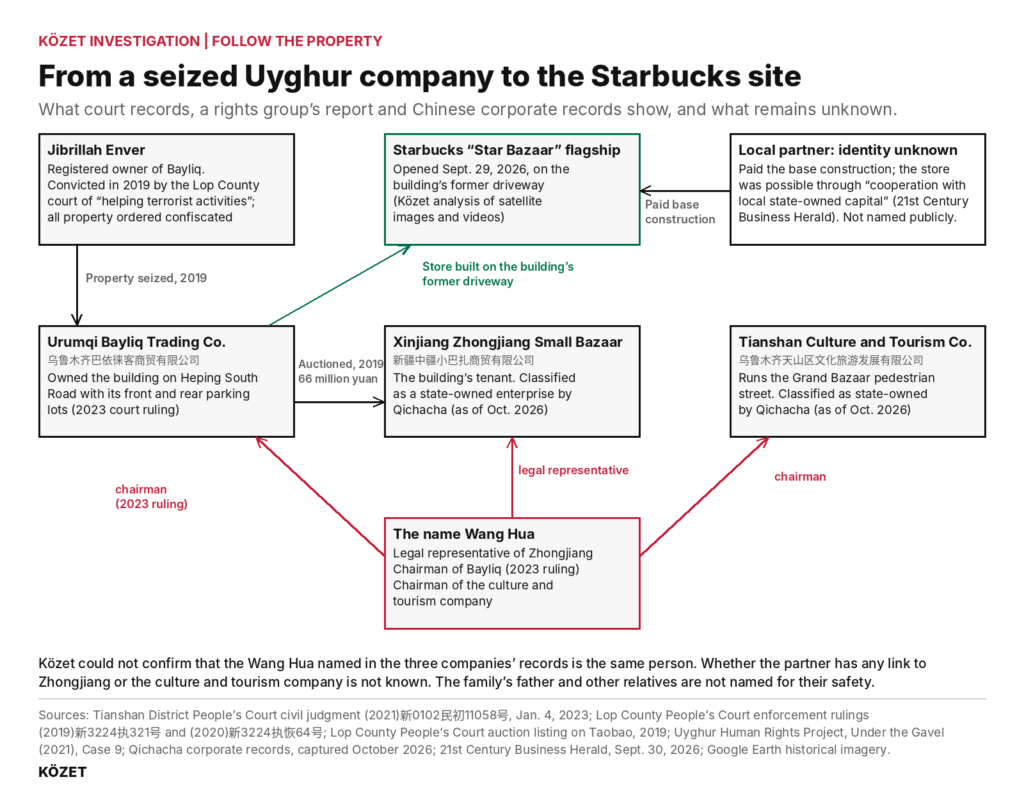
Qichacha now lists Bayliq as deregistered, meaning the company no longer exists. Közet could not determine who now holds title to the building or its land. As of October 2026, Qichacha classifies Zhongjiang, which bought Bayliq at auction, as a state-owned enterprise and lists its legal representative as Wang Hua.
Qichacha also lists a Wang Hua as chairman and legal representative of the Urumqi Tianshan District Culture and Tourism Development Company, which runs the pedestrian street of the Grand Bazaar, a tourist complex in Urumqi, where the Starbucks flagship and the family’s former building stand. Közet could not confirm that the Wang Hua named in the records of Bayliq, Zhongjiang and the culture and tourism company is the same person. The database lists the culture and tourism company as a limited liability company “invested in or controlled by natural persons” and classifies it as a state-owned enterprise. Közet could not determine who ultimately owns it.
Where Starbucks built
The store’s plaque gives its address as 636 Heping South Road, on the edge of the Grand Bazaar, in Urumqi’s Tengri Tagh District, called Tianshan District in Chinese. The court’s auction listing gives the address of the family’s building as 638 Heping South Road, and the company’s registered address, according to the 2023 ruling, was a ground-floor shop there. The flagship’s number, 636, comes right before it.
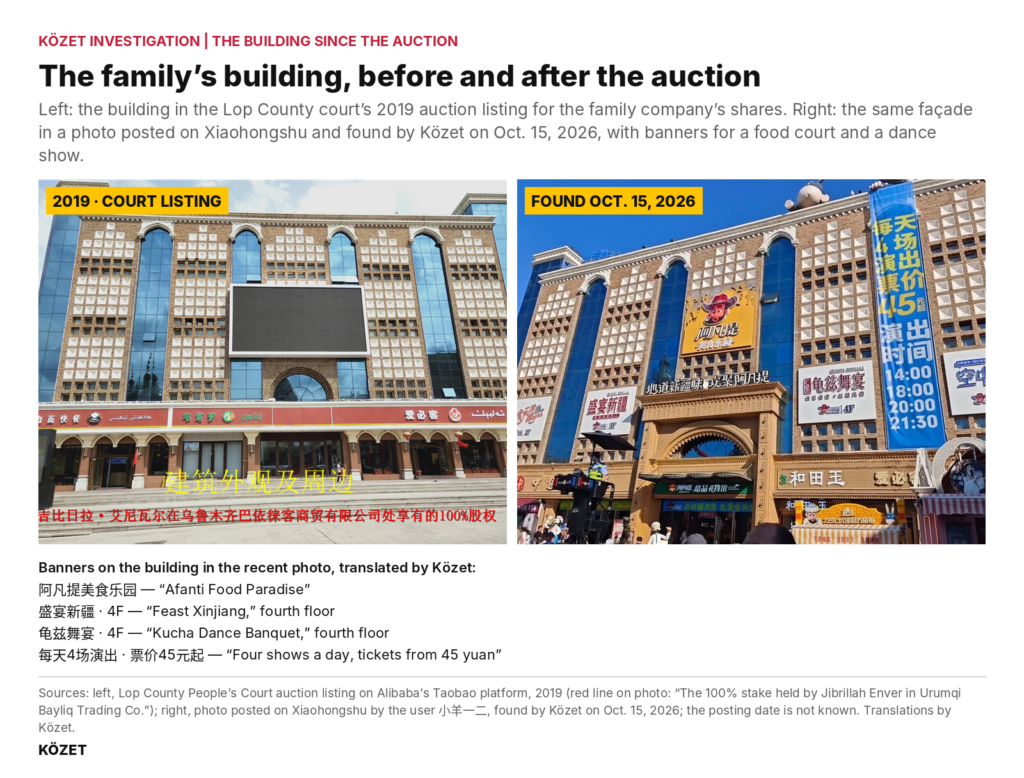
Videos posted by visitors on Chinese social media show the store, which Starbucks calls 星巴扎, Star Bazaar, in front of a tall brown-brick building. Blue glass columns rise at two of its corners, and rows of raised white square panels cover its façade. The businessperson identified it in the videos as the family’s building, and photographs in the Lop County court’s 2019 auction listing show the same building from several sides.
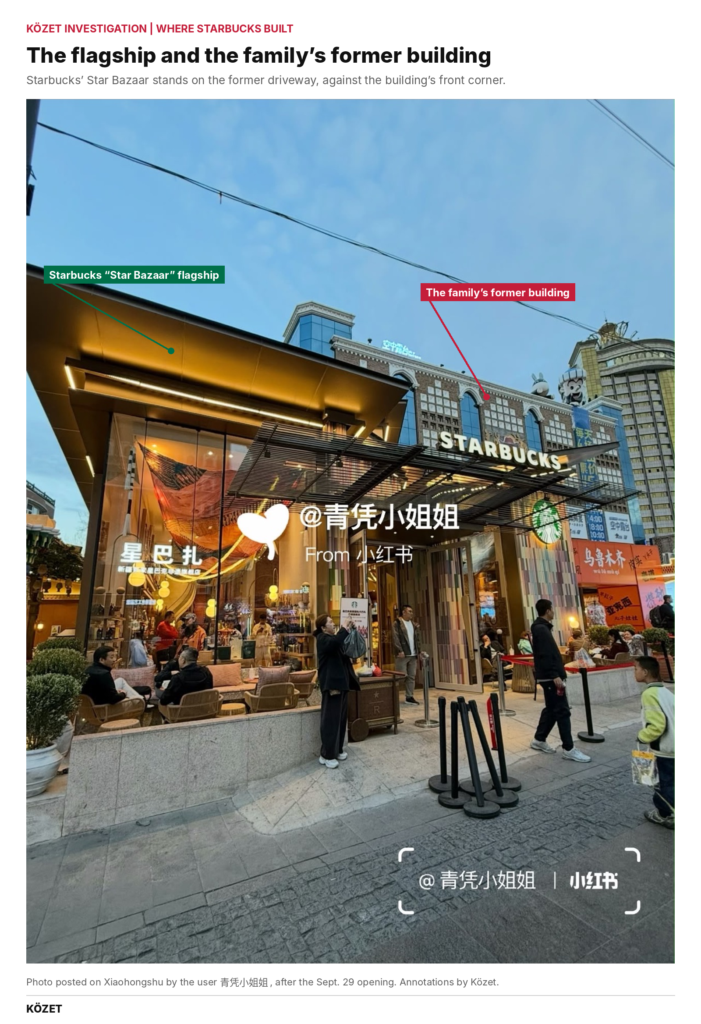
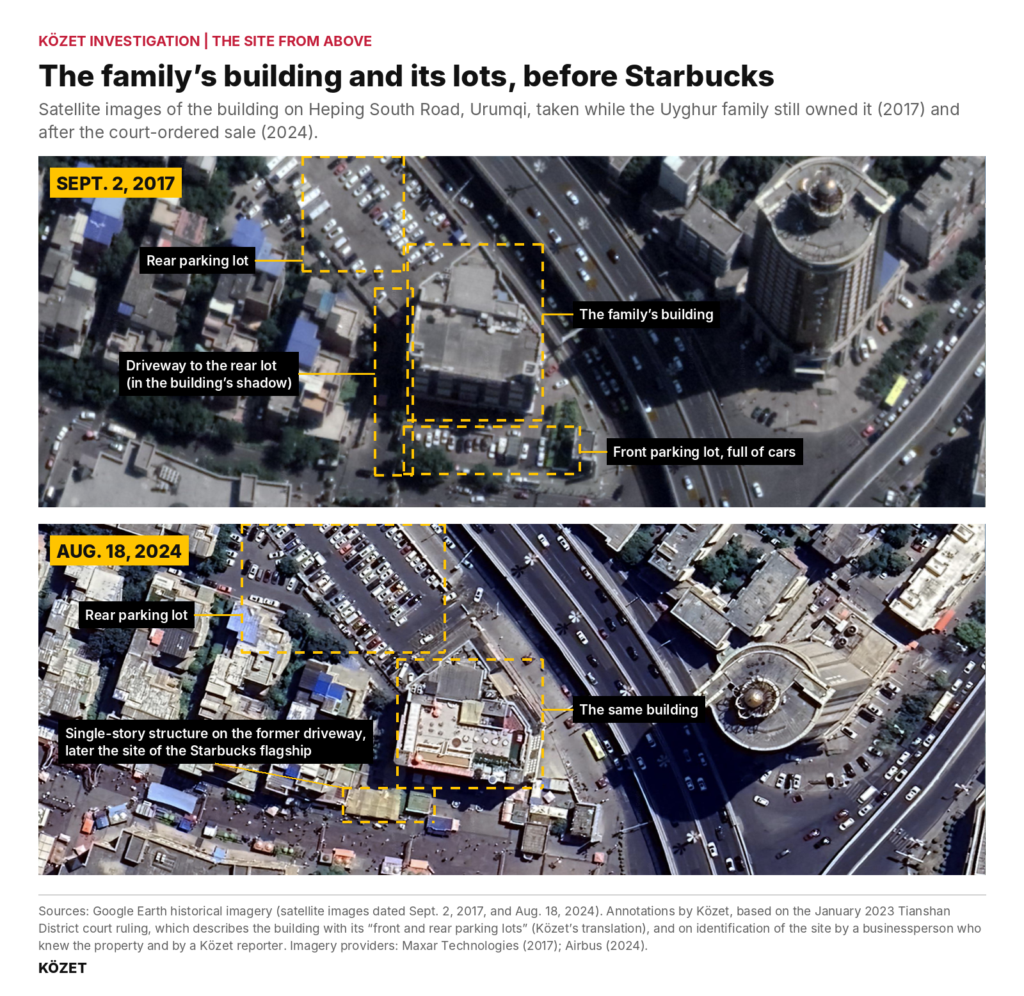
Satellite images reviewed by Közet show how the site changed. In July 2014, after the family bought the building, a driveway ran along its side from the front corner to the lot behind it. In September 2017, while the family still owned the company, cars filled the lots in front of and behind the building. The driveway was still there in April 2022. By August 2024, a single-story structure with a yellow roof stood at its front end. The flagship now stands on the front end of the former driveway, against the building’s front corner, according to the businessperson and Közet’s comparison of the satellite images with videos of the store.
Banners on the building, in a photo posted on Xiaohongshu that Közet found on Oct. 15, advertise a food court, “Afanti Food Paradise,” and a “Kucha Dance Banquet” on the fourth floor, with “four shows a day.” Közet could not determine who runs them.
A Starbucks built with state capital
A local partner paid the flagship’s base construction costs, 21st Century Business Herald, a Guangzhou-based business newspaper, reported from Urumqi on Sept. 30. “The partner is responsible for the base construction costs of ‘Star Bazaar,'” the reporters wrote, “and Starbucks is responsible for the fit-out investment and related design.”
The store is a stand-alone building, modeled on the layered roofs of a traditional bazaar, and the first Starbucks store whose architectural design the company itself led, the paper reported. Such buildings are expensive, it wrote, and Star Bazaar was possible because of “cooperation with local state-owned capital.”
The paper did not name the partner or say how much it spent. Közet could not find the partner named in any public record, and whether it has any link to Zhongjiang or the culture and tourism company is not known. Neither Starbucks nor Boyu answered questions about the partner.
Whose decision
The flagship was one of Starbucks’ first two stores in the region. The other, at Urumqi Tianshan International Airport, opened the same day, Chinese media reported.
21st Century Business Herald quoted Starbucks China’s chief executive, Liu Wenjuan, known in English as Molly Liu, as saying that the company’s entry into the region began to move forward after Boyu took control. Boyu bought 60% of Starbucks’ China retail business in a deal that closed on April 2. The paper wrote that local state-owned capital was among the resources Boyu brought to Starbucks.
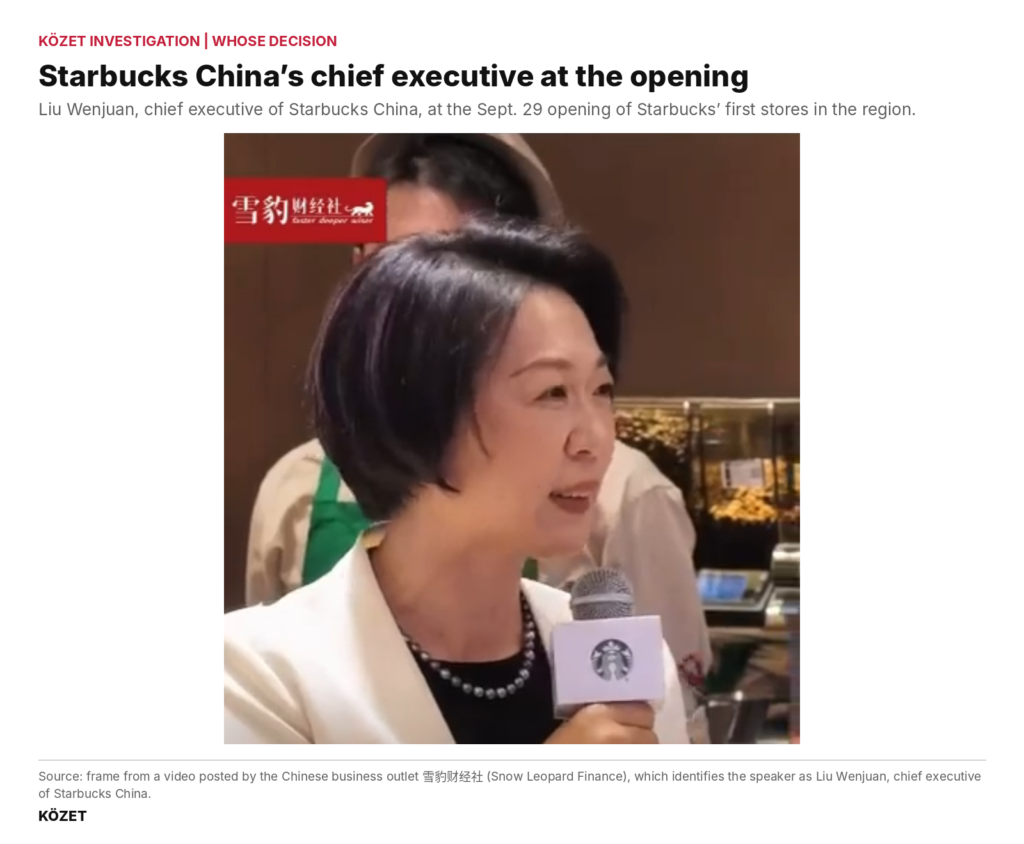
Liu’s account does not say who made the decision. Közet asked Starbucks whether Boyu initiated the move, whether Starbucks Corp. reviewed or approved it, and whether Starbucks’ Global Human Rights Statement and supplier standards cover the venture’s stores. The company did not answer.
Starbucks’ Global Human Rights Statement, published in 2020, says the company respects “the human rights of individuals and communities impacted by our operations and products.” It counts “joint venture partners” among its business partners and says that, “as part of ongoing due diligence,” a Starbucks team “routinely evaluates potential human rights risks in the regions where our Business Partners operate.”
The opening drew criticism in Washington. John Moolenaar, chairman of the House Select Committee on China, called it“a shocking and morally bankrupt decision by a company that prides itself on social responsibility” and said Starbucks “should immediately reverse course and close its stores in Xinjiang.” Asked about the criticism on Oct. 3, Guo Jiakun, a spokesman for China’s Foreign Ministry, said accusations of genocide in Xinjiang were “a naked lie” and that the region enjoys “social stability, economic development, ethnic unity and religious harmony.”
Under the joint venture, Boyu runs Starbucks’ business in China. But the American company still owns 40% of it, licenses its name and logo to every store, and sets the brand standards the cafes must follow. Franchised chains, said Peter Irwin, co-executive director of the Network for Uyghur Rights, a Uyghur organization that supports emerging Uyghur researchers and advocates, find it “easier for them to claim they have no control over their operations. But this ignores the fact that these companies continue to control the [intellectual property] that makes these locations valuable in the first place.”
Irwin placed Western companies operating in the region on a spectrum of harm. At one end, he said, are chains like KFC and Pizza Hut, which opened restaurants in the region in the mid-2000s, “where it’s harder to draw a direct line between their presence and human rights abuses.” At the other, he said, are companies like Hilton, “which built a hotel on the site of a demolished Uyghur mosque, or companies who actively promote state narratives that appropriate Uyghur culture and obscure atrocity crimes.” In 2021, The Telegraph reported that a Hampton by Hilton hotel was being built in Hotan on the site of a demolished mosque. Hilton’s website now lists the hotel as open. Starbucks, Irwin said, “certainly sits towards the latter end of the spectrum.”
Uyghur heritage, without the word “Uyghur”
Starbucks called the store an “intangible cultural heritage flagship,” created with performers of the Twelve Muqam, the Uyghur classical music cycle, and with Atlas silk weavers. Chinese media reported it was the company’s first such store in China.
Its launch video opens on a coffee cup and a man’s voice, speaking Mandarin with a Uyghur accent: “Welcome to our beautiful Xinjiang.” None of the launch posts Közet reviewed uses the word Uyghur.
Over woven panels in the store, a caption credits “an eighth-generation inheritor of Xinjiang Hotan Atlas silk” who “weaves the life cycle of coffee by ancient methods.” It does not name the weaver or call the craft Uyghur, as China’s own national heritage list does. That list has included “Xinjiang Uyghur Atlas silk weaving and dyeing” since 2008, when the State Council added it.
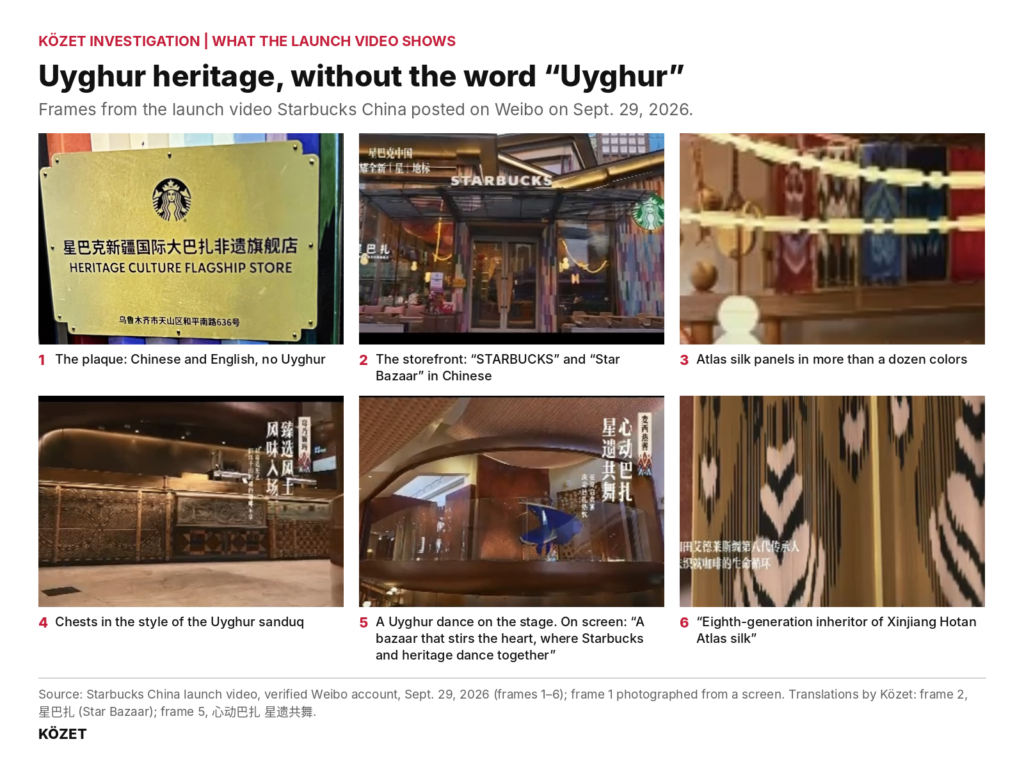
Professional Muqam musicians were among the people detained in the region from 2017, according to a 2023 UHRP report. Starbucks has not named the Muqam performers or the Atlas weavers it worked with. It did not answer questions about how they were chosen or whether they were paid.
In describing its heritage-themed stores in five other Chinese cities, Starbucks has named the ethnic groups behind the crafts. A September 2025 story on the company’s Asia newsroom said products in those stores, “from Bai ethnic resist-dye textiles to Inner Mongolian leather embossing,” are “co-created with rural artisans,” and called the program “a commitment to empower rural women and preserve traditional crafts.”
Gao Yao, a Starbucks China designer, told Xinjiang Daily that the store “deeply integrates” heritage elements such as the “Xinjiang Twelve Muqam,” Atlas silk and traditional ethnic musical instruments.
“‘Xinjiang Twelve Muqam’ erases the Uyghurs who lay claim to this tradition as their own,” said Elise Anderson, director of the Transnational Repression Initiative at the New Lines Institute, a Washington think tank, who spent nearly four years in Urumqi in the 2010s researching the Twelve Muqam.
UNESCO, the United Nations’ cultural agency, lists the music as “Uyghur Muqam of Xinjiang,” phrasing that Anderson said “originated in the Chinese culture bureaucracy” and is “an example of the party-state claiming dominion over the Uyghur homeland and culture.”
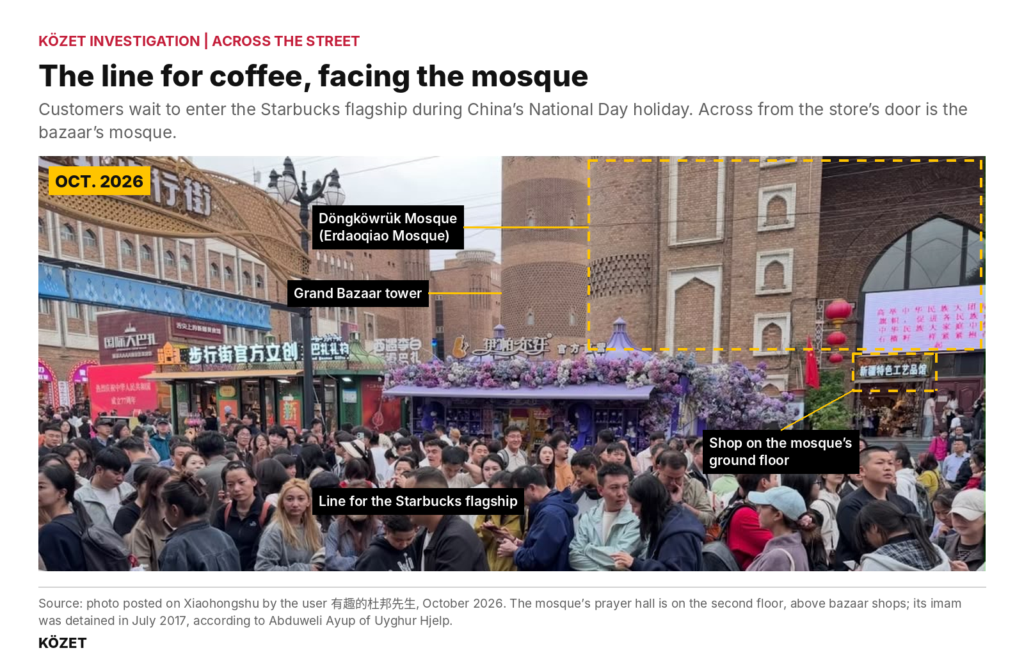
Across the street from the Starbucks flagship is the bazaar’s mosque, known in Uyghur as the Döngköwrük Mosque and in Chinese as the Erdaoqiao Mosque. Its imam was detained in July 2017 and sentenced to 10 years in prison in 2018, said Abduweli Ayup, a Uyghur linguist in Norway and the founder of Uyghur Hjelp, a group that documents the detention of Uyghur religious figures and academics.
Bahtiyar Shahnazar, 62, a Canadian of Uzbek descent from Toronto who visited the Grand Bazaar in September, before the store opened, told Közet the mosque was closed and its ground floor now holds tourist shops. He saw no Uyghur signs on any shops, he said, “other than the mosque signage.”
The signs shown in Starbucks’ launch video are in Chinese and English, with no Uyghur, and none of the images of the store’s signs and menus that Közet reviewed through Oct. 20 included Uyghur. The region’s language regulation requires public signs and notices in public places and service businesses to carry Chinese together with the script of a local ethnic language. Közet asked Starbucks whether the flagship displays any signs in Uyghur and, if so, for photographs of them. It did not respond.
During China’s weeklong National Day holiday, which began Oct. 1, some customers waited one to two hours to get in, Xinjiang Daily reported on Oct. 12. Since Oct. 1, Starbucks China has kept replying on its official Chinese social media accounts to fans who posted about the “Xinjiang specialty” menu. “Welcome to Star Bazaar,” the company wrote.
How we reported this
Közet’s account of the seizure and sale rests on Chinese court records: the Tianshan District People’s Court’s 2023 civil judgment, (2021)新0102民初11058号, reviewed in an archived copy from China Judgments Online; two Lop County People’s Court enforcement rulings, (2019)新3224执321号 and (2020)新3224执恢64号, in copies preserved in the Internet Archive; and the court’s auction listings on Taobao, item 596820652433, and on the China Association of Auctioneers’ platform, lot 3688. The 2019 ruling cites the criminal judgment that convicted Jibrillah, (2019)新3224刑初142号, which Közet could not locate. Közet also drew on Qichacha corporate records, captured in October 2026, and on UHRP’s 2021 report Under the Gavel.
To place the store, Közet compared visitors’ videos from Chinese social media with Google Earth satellite images of the site, taken between 2014 and 2024, and a 2018 Google Earth photo. The site is at about 43.7783° N, 87.6168° E. The businessperson and the reporter who wrote this article, who lived in Urumqi until 2017, separately identified the building. Közet could not visit the site.
Közet interviewed the businessperson by phone in Uyghur; the quotes are Közet’s translations. That Jibrillah Enver is the young man’s older brother comes from the businessperson. Court records are consistent with that but do not name the two as brothers. Others quoted were interviewed by phone or answered questions in writing. To avoid putting the family at risk, Közet did not contact family members, anyone else in the region, Zhongjiang, the culture and tourism company or the Lop County court, and it is not naming other family members.
Közet reviewed Starbucks China’s social media posts from Sept. 29 through Oct. 20 and Chinese media coverage from Sept. 16 to Oct. 20, preserved as screenshots and recordings. Between Sept. 29 and Oct. 16, Közet sent Starbucks questions and then its findings, and left a message on its media line; it received only automated acknowledgments. Boyu Capital, which Közet wrote to on Oct. 13 and Oct. 16, and the Chinese Embassy in Washington did not respond. Közet will update this report if any of them does. Dollar figures are conversions at the exchange rates of the time.
Do you have information about property seized from Uyghur families, or about this story? Contact Közet at contact@kozet.org.
Kasim Kashgar is the founding executive director of Uyghur Monitor, the nonprofit news organization that publishes Közet. From 2019 to 2025 he covered the Uyghur region and diaspora for Voice of America. He is a 2026-27 fellow at the Dorothy and Lewis B. Cullman Center for Scholars and Writers at the New York Public Library and at the Witness Institute.
© 2026 Uyghur Monitor Inc. This investigation may not be republished without permission. For republishing requests, contact republishing@kozet.org.