Chinese embassy official helps unveil ‘European Xinjiang Cultural Association’ in Budapest
NEW YORK — A Chinese embassy official, the vice chair of a Communist Party-led organization for overseas Chinese and the association’s president unveiled the plaque of a “European Xinjiang Cultural Association” in Budapest on Nov. 1, according to a Nov. 3 Chinese-language report on a diaspora news platform.
The association was publicly identified at least 21 months earlier. A January 2025 report by the Hungarian European Forum, reproduced on the website of the Hungarian New Guide, a Budapest Chinese-language outlet, identified Zhang Yiqiu as its president. On Feb. 1, 2025, the association signed a cooperation agreement in Budapest with a Hungarian business and education federation.
The Nov. 3 report nonetheless described the association as having been “formally unveiled and established” (正式揭牌成立) on Nov. 1. The reports do not explain the gap, and they do not give the association’s founding date, its registration status in Hungary, its funding sources or its membership.
Közet could not identify a contact address for the association. The Chinese Embassy in Hungary did not respond to questions about its establishment and activities.
The World Uyghur Congress, a Munich-based organization founded in 2004 by Uyghur exile groups, views the events “as part of a sustained Chinese government campaign to whitewash the Uyghur genocide,” Gheyyur Qurban, the group’s director of programs, said in an email.
The United States government determined in January 2021 that China’s treatment of Uyghurs amounted to genocide and crimes against humanity. The UN human rights office said in August 2022 that the extent of arbitrary and discriminatory detention of Uyghurs and other Turkic peoples in the region may constitute international crimes, in particular crimes against humanity. China rejects both findings.
‘Started from zero’
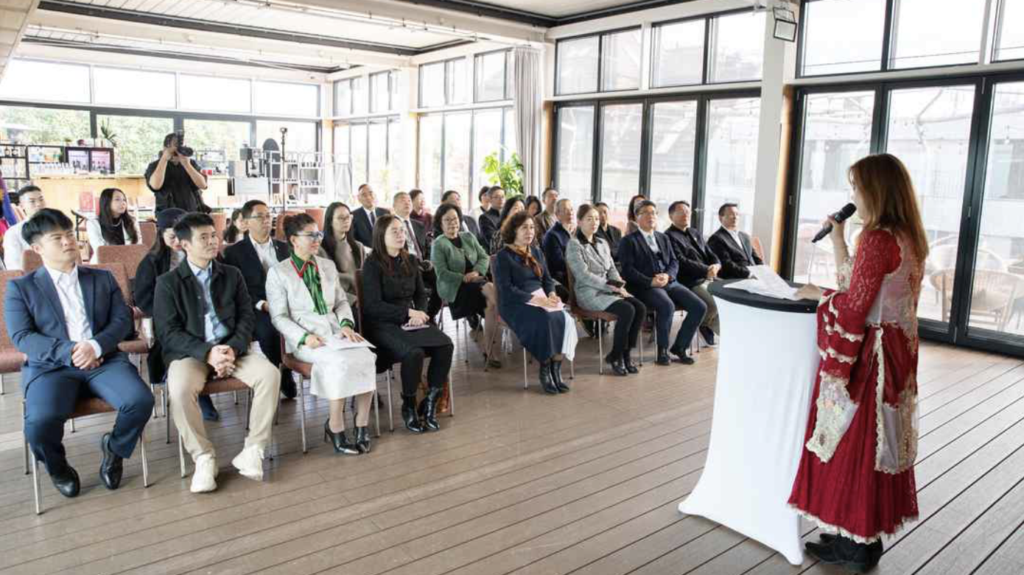
Two reports of the ceremony appeared on Huaren Toutiao, a Chinese-language news platform for the diaspora. The Nov. 3 report said the plaque was unveiled by Hu Qiao of the Chinese Embassy, Mihrigul Haji (米海尔古丽·阿吉) of the Xinjiang Federation of Returned Overseas Chinese and Zhang. A longer report posted Nov. 4 under the Hungarian New Guide’s account is credited to an intern reporter and carries about two dozen photographs and a video.
Közet has found no independent description of the event. The details below are from the Nov. 4 report; quotations are Közet’s translations from the Chinese.
The federation is the regional affiliate of the All-China Federation of Returned Overseas Chinese, whose charter, revised in September 2023, describes it as a national people’s organization under the leadership of the Chinese Communist Party. That relationship does not by itself establish who owns, funds or directs the Budapest association.
At the unveiling, Mihrigul Haji, the federation’s vice chair, who led the visiting delegation, congratulated the association on the federation’s behalf and thanked the Chinese Embassy, community leaders and business owners for their “support and contributions,” the report said.
Hu Qiao, head of the embassy’s consular and overseas Chinese affairs section, gave the closing remarks, saying the association had “started from zero” and was promoting understanding among local residents through “vivid displays of ethnic culture,” the report said. A consul, Wang Kaini, also attended.
“A cultural performance cannot establish freedom of cultural life,” Qurban of the World Uyghur Congress said. “Uyghur songs, dances and traditional clothing on a stage tell us little about whether Uyghurs can teach their language, practice their religion, preserve their history or speak openly without fear of punishment.”
The delegation also included officials of the region’s culture and tourism department, commerce department and overseas Chinese affairs office, the report said.
The director of the Budapest China Cultural Center, Wang Rudong, and the director of the Confucius Institute at Eötvös Loránd University, Li Denggui, were among the guests, it said.
The association’s executive president, Hong Weijun, said the day’s theme was “gather overseas Chinese strength, promote unity, tell the story well, win-win cooperation,” and that the association would act as a bridge to “connect Xinjiang’s advantageous resources with the overseas Chinese resources of Hungary and Europe,” the report said.
Zhang said the association would be based in Hungary and extend its activities across Europe, focusing on people-to-people cultural exchange, services for the diaspora and youth exchange, and expanding “in due course” into education, tourism and trade.
Delegation members promoted the region’s pilot free trade zone and the 2027 China-Eurasia Commodity and Trade Expo and invited diaspora business owners to exhibit, visit and invest. Community representatives then spoke on topics the report listed as including “opposing ‘independence’ and promoting reunification.”
A regional tourism film was screened before the plaque was unveiled, and association members performed songs and dances.
Mihrigul Haji told the gathering the federation runs training for overseas community leaders, “root-seeking” trips and tours of the region for foreign media in order to “tell the Xinjiang story well,” the report said.
The report named three “student representatives” of the association and an employee of Shanghai Electric described as an overseas Chinese from the region. Közet is not publishing their names.
Munich, two days earlier
Mihrigul Haji, who led the delegation at the Budapest unveiling, also attended a “Beautiful Xinjiang” cultural reception at China’s Consulate General in Munich on Oct. 30, the consulate said in a report published Nov. 4.
More than 100 people from Bavarian political, business, educational, media and overseas Chinese circles attended, the consulate said, without identifying any of the Bavarian attendees. Közet could not verify the figure.
Consul General Qiu Xuejun told guests he hoped they would “understand the real Xinjiang,” and the Munich Huaxing Art Troupe performed, the consulate said. The consulate and the Bavarian State Chancellery did not respond to questions, including whether any state official attended.
The reception took place during German President Frank-Walter Steinmeier’s Oct. 27 to 31 state visit to China. Before the visit, the World Uyghur Congress had urged him to raise the treatment of Uyghurs with his hosts.
“A consulate-sponsored event here brings Beijing’s narrative directly into a city where Uyghur survivors and advocates have built a strong public voice,” Qurban said.
Earlier events
On April 14, 2025, Ambassador Gong Tao and Yu Jie, a deputy director of the regional culture and tourism department, spoke at a “Xinjiang Is a Good Place” tourism promotion in Budapest organized by the Budapest China Cultural Center and the Network of International Culturalink Entities, an arm of China’s Ministry of Culture and Tourism, with the embassy’s “special support,” the network said.
About 160 people attended, among them Annamária Horváth of the Hungarian National Tourism Agency, who also spoke.
A comparable ceremony took place in Seoul. On March 7, 2026, a “Chinese Xinjiang Cultural Exchange Association in Korea” was founded there; Zhong Hongnuo, minister-counsellor and consul general at the Chinese Embassy, joined other guests in cutting the ribbon, a congratulatory letter from the Xinjiang federation was read aloud and the chair of its youth committee spoke by video, China News Service reported.
In Central Asia, Chinese diplomatic missions have hosted exhibitions, performances and receptions promoting the region since 2023. These included an art and photography exhibition at the Consulate General in Almaty in August 2025 and a presentation and photo exhibition marking the autonomous region’s 70th anniversary at the Chinese Embassy in Bishkek on Oct. 27, 2025, with more than 150 guests, the Foreign Ministry said. A “Xinjiang Is a Good Place” culture and tourism promotion followed in Almaty on Dec. 13, 2025, with more than 300 attendees, according to the consulate.
Regional governments have also set up business bodies there. On Oct. 12, 2023, a “Kyrgyzstan Central Asia Kizilsu Chamber of Commerce” was founded in Bishkek before about 120 people, including officials of Kyrgyzstan’s Ministry of Economy and Commerce and the staff of the Kizilsu prefecture’s representative office in the country, the prefecture’s commerce bureau reported.
That chamber is a commercial body; the Seoul and Budapest associations are cultural ones launched with embassy officials and the overseas Chinese federation taking part.
Since 2024 the regional culture and tourism authorities have carried out “32 batches” of overseas exchange and cooperation activities in 21 countries and regions, China Culture Daily reported in May 2025.