
Uyghur, Uighur, or Uygur? The three spellings of one name, and which one Közet uses
A note on the different English spellings of a Turkic ethnic group at the center of Közet’s coverage, and why Közet uses just one of them.
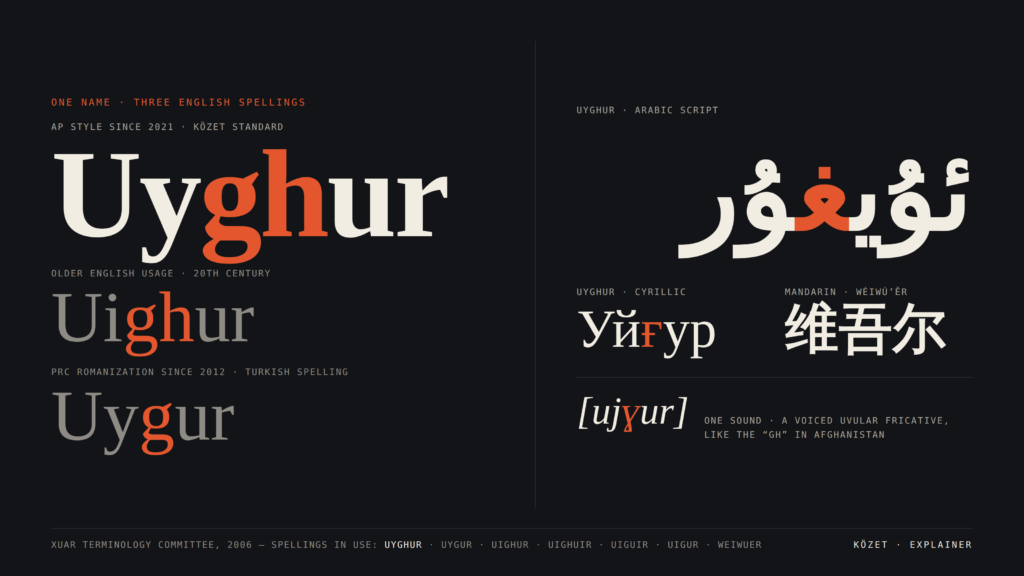
Readers will sometimes encounter more than one English spelling for the Turkic ethnic group at the center of much of Közet’s coverage: Uyghur, Uighur, and Uygur. The three forms refer to the same people, but they are not interchangeable house-style variants chosen at random. Each has a distinct origin, and using one over another is not a neutral choice — it can align a piece of writing with a particular institution, era, or side of an ongoing dispute over how to describe the group. This note explains where each spelling comes from and which one Közet uses.
Uyghur
“Uyghur” is the spelling currently used by the AP Stylebook, most major international outlets, and Uyghur organizations and individuals writing in English themselves; AP adopted it in 2021, saying it better reflects transliteration from the Uyghur alphabet, the script Uyghur is written in, than the earlier spelling did. It is Közet’s standard spelling in its English-language copy. This is specifically an English spelling question: it does not extend to Közet’s Mandarin-language edition, or to its Uyghur-script and Cyrillic-script Uyghur editions, which render the name in non-Latin characters. It does extend to Közet’s Uyghur Latin-alphabet edition, which spells the name the same way, “Uyghur.”
Uighur
“Uighur” is an older English spelling, common in scholarship, journalism, and official documents through the 20th century, and still found today in earlier archival material, older books, and some institutions that have not updated their style. It represents the same underlying name; Közet preserves it only inside a direct quotation or a proper name, such as an organization’s own name, that uses it.
Uygur
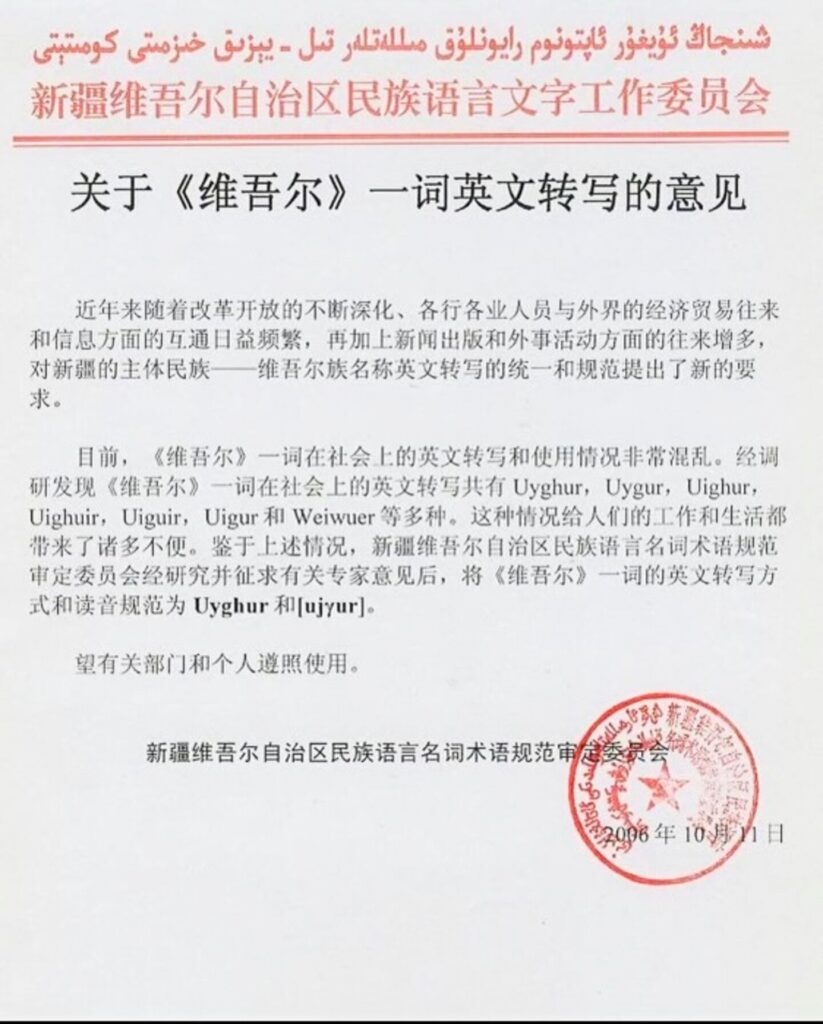
“Uygur” is the Chinese government’s own romanization of the name, and reflects a 2012 reversal of the region’s own earlier standard. Közet has reviewed a copy of the directive that set the region’s earlier standard: issued October 11, 2006, by the Xinjiang Uyghur Autonomous Region’s own Ethnic Language Terminology Standardization Committee, it described “very chaotic” use of seven competing English spellings at the time — Uyghur, Uygur, Uighur, Uighuir, Uiguir, Uigur, and Weiwuer among them — and standardized the English transliteration as “Uyghur,” with the pronunciation specified as [ujɣur]. The Communist Party-owned China Daily reported on May 15, 2012, that this had been superseded and the spelling re-standardized as “Uygur,” according to reporting from the U.S. government-funded Radio Free Asia; unlike the 2006 directive, the underlying 2012 order does not appear to be independently documented. “Uygur” appears throughout Chinese state media’s English-language output, and in the region’s own official English name, the Xinjiang Uygur Autonomous Region.
Some Uyghur linguists and advocates argue the spelling with an “h” is phonetically more accurate, since the sound in question, a voiced uvular fricative, is closer to the “gh” in “Afghanistan” than to a plain “g”. Others go further, arguing that Beijing’s 2012 reversal to “Uygur” was a deliberate move to fragment Uyghur identity, and that it has had the effect of making it harder to find Uyghur-authored material and rights documentation online, since search engines and databases do not always treat the two spellings as equivalent. That argument does not extend to every use of “Uygur,” however. Modern Turkish orthography has no “gh” digraph. Turkish accordingly spells both “Afghanistan” and “Uyghur” without an h, as “Afganistan” and “Uygur”; that spelling is standard across Turkish-language sources generally, including Turkish-language Uyghur rights and advocacy organizations, for a reason unrelated to Beijing’s own usage. Közet preserves it only inside a direct quotation or a source’s own name that uses it.
This note is part of Közet’s Explainer series, standing background reporting on the terms, history, and disputes that recur in its coverage. It is reporting in its own right, not a disclosure of method, and will be updated as usage or the underlying facts change.