Report finds China’s forced labor of Uyghurs amounted to enslavement, a crime against humanity
NEW YORK — Forced labor in China’s internment camps for Uyghurs and other Turkic and Muslim-majority peoples amounted to the crime against humanity of enslavement, and the government’s labor transfer program has in many instances done the same, according to a report commissioned by Anti-Slavery International. The report says foreign companies operating in or sourcing from the Xinjiang Uyghur Autonomous Region should leave.
The London-based group published the report on Wednesday under the title “State-Imposed Forced Labour and Crimes Against Humanity in the Uyghur Region: The Corporate Responsibility to Act.” In the camps, which China calls vocational education and training centers, state authorities “exercised powers of ownership over detainees,” the group said. It said forced labor in the camps peaked between 2017 and 2019.
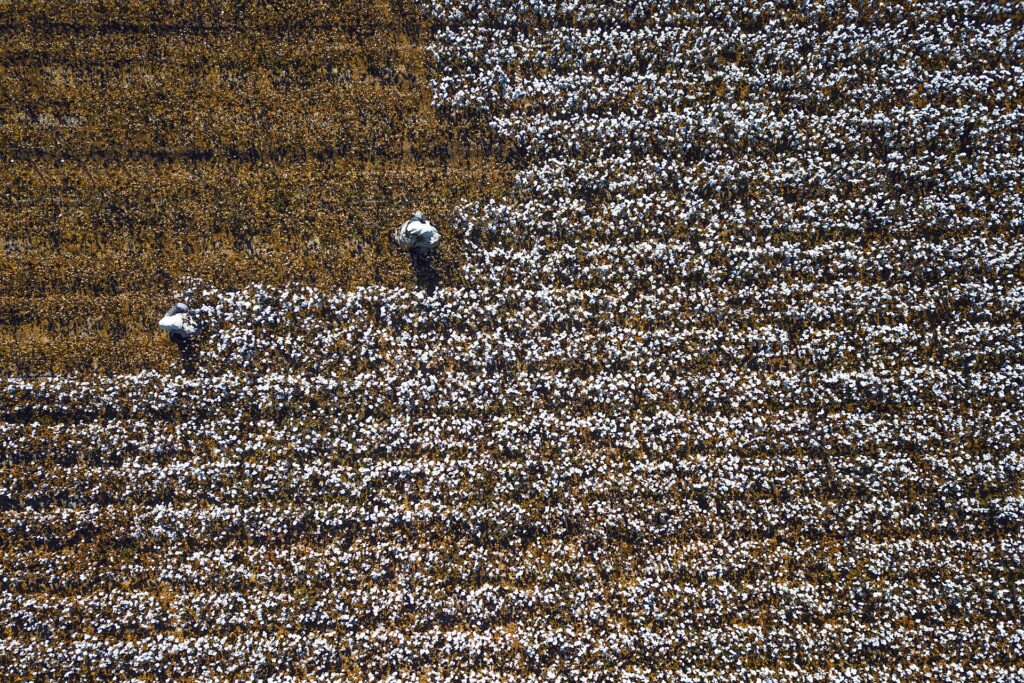
Labor transfers are now the main form of state-imposed forced labor, the group said. The program moves people, mostly farmers of small plots, into factory work or industrial agriculture. The group said the transfers operate in a coercive environment that includes threats of detention and related violence. “In many instances, this policy has resulted in the commission of the crime against humanity of enslavement,” it said.
China denies that forced labor exists in the region. On Oct. 29, after the United States added more Chinese companies to its Uyghur Forced Labor Prevention Act entity list, Foreign Ministry spokesperson Guo Jiakun called the allegation a “lie of the century” made up by anti-China forces to destabilize the region and contain China’s development.
The report says that if the Chinese government disputes its findings, it should give independent experts direct access to Uyghurs and other Turkic peoples in the region.
Anti-Slavery International commissioned the report in 2025 from three outside experts. Rian Thum, a professor of Asian history at the University of Manchester, wrote the factual account. Wayne Jordash, a British King’s Counsel and managing partner of the law firm Global Rights Compliance, wrote the legal analysis. Tara Van Ho, an associate professor at St. Mary’s University School of Law in San Antonio, wrote the section on business responsibility. Two of the group’s staff members served in what the report calls a “coordination, advisory and editorial capacity.”
The authors analyzed existing testimony, evidence and research and gathered no new testimony, the report says. Each section was peer reviewed by an independent expert who chose to remain anonymous.
In 2022, Tomoya Obokata, the UN special rapporteur on contemporary forms of slavery, said some instances of forced labor in the region “may amount to enslavement as a crime against humanity, meriting a further independent analysis.” The report says it provides that analysis.
Legal findings
Jordash’s analysis uses the Rome Statute of the International Criminal Court as its framework. It applies the “reasonable grounds to believe” standard of proof, the threshold the court uses to issue arrest warrants. The report says the court does not have jurisdiction over the alleged crimes and is unlikely to have it in the future. China is not a party to the statute.
Jordash concludes that the camps and labor transfers formed part of an attack on the Uyghur civilian population carried out under state policy. “There can be no reasonable doubt that this attack was/is both widespread and systematic,” he writes. He finds an underlying motivation “to target Uyghurs for their religious and cultural expression.”
Thum’s section says central government documents indicate that “the overriding goal of these policies is security.” It says government documents tie that security threat to Uyghurs, Kazakhs and other Turkic-speaking, Muslim-majority groups.
Jordash stops short of finding that the entire labor transfer system amounts to enslavement. He finds that it does in some instances, particularly assignments far from workers’ homes. He says more evidence is needed because most transfers are to jobs near home, which appear to involve less control over workers.
He writes that some people may take part voluntarily. He notes that a report by a research institute at Nankai University classed about 30% of cases in Hotan prefecture as voluntary. But he says the coercive environment creates “the strongest of presumptions of involuntariness.”
The analysis draws no conclusions about prison labor, saying it could not examine conditions of detention. It also says it did not comprehensively examine other likely crimes against humanity, including torture, sexual violence and persecution.
State media regularly report 2 million to 3 million labor transfers a year, Thum writes. Those figures count each assignment rather than each person, and he estimates that the number of people currently in transfer assignments is in the millions. Most assignments are near workers’ homes. In the first 10 months of 2018, 25,378 transfers went to other provinces, according to state media figures cited in the report.
“Due to the extensive use of labour transfers, goods produced with Uyghur forced labour may be found across China,” said Cara Priestley, the group’s international and thematic advocacy manager. “This makes the entire country a high-risk area for business, not just the Uyghur Region.”
‘Responsibly exit’
Van Ho’s section says that every business operating in or sourcing from anywhere in China must carry out heightened human rights due diligence. It says such due diligence is currently impossible inside the Uyghur region because the people affected “cannot participate without fear of reprisal.”
The report says foreign businesses that operate in or source from the region, including locally incorporated subsidiaries, “are therefore contributing to the crime against humanity of enslavement.” It says they should leave the region and end their contracts with suppliers there.
The report says some businesses will need to leave China entirely. It says companies should also set up grievance mechanisms, keep records of their involvement and create reparations funds for victims. “Reparations are never ‘impossible,’ only delayed,” it says.
Van Ho’s section does not examine whether business leaders could face criminal liability. It does say governments should investigate, prosecute and punish those complicit in the crimes, including business leaders.
The report also says two Chinese State Council decrees create legal risk for multinational companies that must comply with foreign due diligence and import-ban laws. One of them, issued in April 2026, is titled Regulations on Countering Improper Extraterritorial Jurisdiction by Foreign States. The report says the region’s 2026 state secrets regulations further criminalize sharing information about regional policies or conditions with foreign entities, journalists or investigators.
“Companies have a moral obligation to remove themselves from situations where their presence or investments may contribute to suffering or injustice,” said Patricia Carrier, the group’s business and human rights adviser. “And now, with this finding, there are legal implications that add further urgency to this obligation.”
The group called on businesses to disengage from the region. It called on governments to pass laws that would hold accountable businesses complicit in atrocity crimes.
Earlier findings
The United States government determined in January 2021 that China’s treatment of Uyghurs amounted to genocide and crimes against humanity. In August 2022, the UN human rights office said the extent of arbitrary and discriminatory detention of Uyghurs and other Turkic peoples in the region may constitute international crimes, in particular crimes against humanity. China rejects both findings.