
China to end Uyghur language’s equal legal status with Chinese in its Uyghur autonomous region
NEW YORK — From January 1, 2027, the government of the Xinjiang Uyghur Autonomous Region in northwest China will have to work in Chinese but will no longer have to use Uyghur alongside it, ending a requirement as old as the region’s autonomy.
In 1956, nine months after the region was established, the regulation organizing its government required its people’s congresses and people’s committees to work in Uyghur and Chinese, naming Uyghur first. China’s Constitution still provides that the governments of autonomous areas use the locally common languages in their work.
The revised regional regulation makes Chinese the working language of state organs and permits Uyghur as official business requires. It also removes an explicit guarantee that Uyghur has equal legal effect with Chinese in government work, last recorded in the region’s 2015 revision.
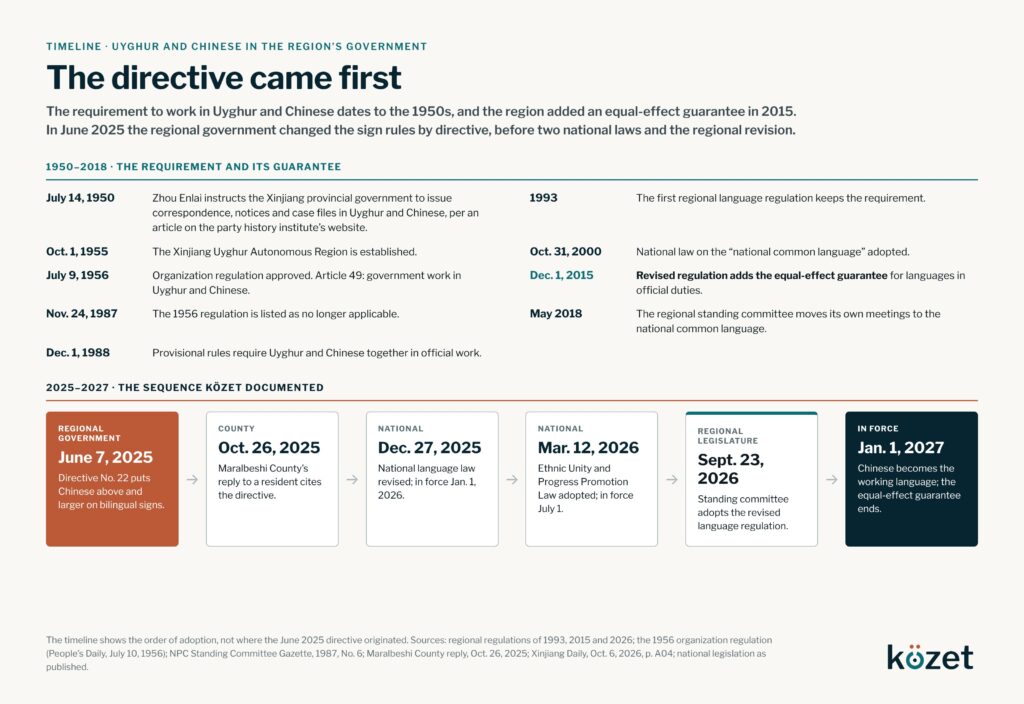
The shift did not begin with the legislature. In June 2025, fifteen months before the standing committee of the regional people’s congress adopted the revision on September 23, 2026, the regional government office issued a directive putting Chinese first on bilingual signs.
The directive came to light only through a complaint. In October 2025, a resident of Maralbeshi County wrote that shops and institutions were being told to put Chinese above Uyghur on their signs or take the Uyghur down, an allegation Közet could not independently verify. The county’s reply, posted on its website, cited the directive. Közet found no government body that had published it.
A Közet comparison of the 2015 and 2026 texts and of government records shows three things. The June 2025 directive reversed a 2011 rule that put local-language text above Chinese on stacked doorplates and seals. The revision does more than end the bilingual requirement and the guarantee: it also withdraws the duties, the local translator requirement and the fines that gave those rules force.
And Article 21 of the national Regional Ethnic Autonomy Law still allows the region to make Uyghur the principal language of its own organs, although the national language law, as revised in 2025, makes Chinese the language of official business for state organs unless another law provides otherwise. The region’s legislature, which Chinese law places under Communist Party leadership, did not use the latitude Article 21 leaves. The new text says the region will “respect and guarantee” the learning and use of minority languages, the government’s term.
“That is a significant shift from a promise of institutional equality towards administrative discretion,” James Leibold, an emeritus professor at La Trobe University in Melbourne who studies the Chinese Communist Party’s ethnic policy, told Közet. Removing equal legal effect from the regulation, he said, “illustrates how the Party can hollow out autonomy without formally abolishing it.”
The regional government office and the Maralbeshi County government did not respond to written questions.
A guarantee written in 2015, gone in 2027
The Regulation on Spoken and Written Language Work was first adopted in 1993 and required the region’s organs of autonomous government, its people’s congresses and people’s governments, to use Uyghur and Chinese together when performing their duties. The 2015 revision named the national common language first and Uyghur second, and added a sentence: “In the performance of official duties, minority languages and scripts have equal effect (同等效力) with the national common language and script.”
The term “minority languages” is the government’s, and the clause covered the languages of all the region’s nationalities, not Uyghur alone. The same article allows the language of the group exercising regional autonomy to serve as the principal one. Chinese law defines the national common language (国家通用语言文字) as Putonghua, the standard spoken form, and standardized Chinese characters.
The sentence does not appear in the 1993 regulation or its 2002 amendment, or in the regional government’s earlier provisional rules on the use of languages and scripts, approved on December 1, 1988, as Government Order No. 3. All three required Uyghur and Chinese to be used together in official work and stated a general principle of equality among the languages of all nationalities, but none expressly stated that the languages had equal legal effect in official duties.
The 1988 rules also required both scripts on seals, doorplates, documents and public signs. Közet located the 1988 text in a legal database reproduction and has not authenticated it against an official publication. The equal-effect sentence entered regional law on December 1, 2015, and will be removed when the revised regulation takes effect on January 1, 2027.
The 2026 regulation’s Article 12 reads: “State organs use the national common spoken and written language for official business; in performing their statutory duties they may, as official business requires and in accordance with law, also use the locally common minority languages and scripts.” The first clause designates a working language (以…为, “use… as”); the second grants permission (可以, “may”).
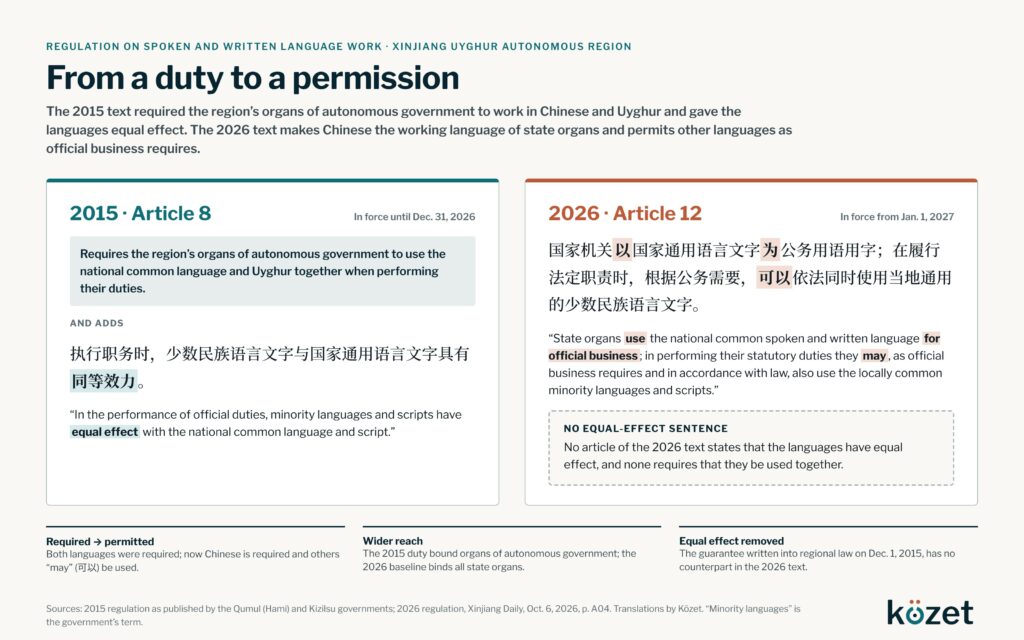
The article also addresses a wider category than its predecessor: the 2015 duty to use both languages applied to the organs of autonomous government, while the new Chinese-language baseline applies to state organs generally, which in Chinese law include legislatures, courts and procuratorates as well as governments. No article of the revised text states that the two languages have equal effect, and none requires that they be used together.
The 2015 text attaches concrete duties to the principle. Article 13 requires normative documents binding on citizens and organizations to be issued in both languages. Article 15 requires materials for admission, recruitment, promotion and skills examinations to be supplied in both languages according to the circumstances of the candidates, who may choose either, subject to other national or regional provisions.
Article 17 requires state organs, judicial bodies and people’s organizations handling letters, visits and other official business to use a language the citizen understands or provide translation, and bars staff from refusing or delaying service on the ground that they do not understand the citizen’s language.
The revised regulation contains no equivalent to any of these three articles.
Leibold, who noted that he is not a lawyer, said the earlier regulation “imposed explicit duties to provide bilingual official documents and to communicate with citizens in a language they understood, or provide translation, so Uyghur-language access was not simply discretionary.” “The revision removes those safeguards and gives officials greater discretion,” he said, “although the ‘equal-effect clause’ alone never guaranteed every document or response in Uyghur.”
The changes reach staffing and enforcement as well. The 2015 regulation’s Article 28 requires townships and subdistrict offices in areas the text describes as having concentrated “minority” populations to employ at least one full-time or part-time translator.
Article 27 requires public-facing agencies, among them transport, health, taxation, public security, postal and financial services, to train staff to serve residents in the locally common languages, and Article 20 requires postal and financial institutions to handle mail and services in local scripts.
The revised regulation keeps general provisions on translation work and professional translators but sets no minimum number of translators at local offices and carries no equivalent of Articles 20 and 27. It adds standards of its own: Article 24 requires translation work to follow the prescribed political direction and says terms that cannot be adequately expressed in a local language should be borrowed from the national common language, and Article 25 applies political and technical standards to translation software.
The official Uyghur-language press already borrows from Chinese. The regional government’s news portal called itself Tengritagh Tori on its Uyghur pages in 2017, using the Uyghur name for the Tianshan mountains; by 2025 it was Tianshan Tori, the Chinese name in Uyghur script. Since at least May 2018 its Uyghur pages have written “university” as a transliteration of the Chinese daxue (大学), though Uyghur has long used uniwérsitét, and “school” or “college” as xueyuan (学院) rather than institut. A party secretary is a shuji (书记), not a sékrétar, and the banana is xiangjiao (香蕉), not banan.
The revision also removes the regulation’s specified financial penalties for violations of the earlier language-use rules. The 2015 regulation’s Article 37 authorizes fines of 500 to 5,000 yuan for enterprises that fail to correct violations, and Article 38 fines of 1,000 to 10,000 yuan, with possible suspension of business or loss of licenses, for translation and sign-making firms.
The revised text’s chapter on legal responsibility has two articles, one on official misconduct and one referring other violations to applicable laws and regulations, and no specified fines. The revision does not remove penalties that other laws may impose.
Citizens’ right to use their own language in court remains separately protected under China’s national procedure laws, including Article 9 of the Criminal Procedure Law, Article 11 of the Civil Procedure Law and Article 9 of the Administrative Litigation Law, and under Article 47 of the Regional Ethnic Autonomy Law. The 2026 regional revision does not amend those national guarantees.
A directive known only from a county’s reply
The resident wrote to the Maralbeshi County government on October 25, 2025, about signs used by shops and institutions in Seriqbuya (Selibuya) and Yengi Östeng (Yengistang); the county replied the next day. Maralbeshi, known in Chinese as Bachu, is the northeastern county of Kashgar Prefecture, in the far southwest of the region near the borders with Kyrgyzstan, Tajikistan and Pakistan.
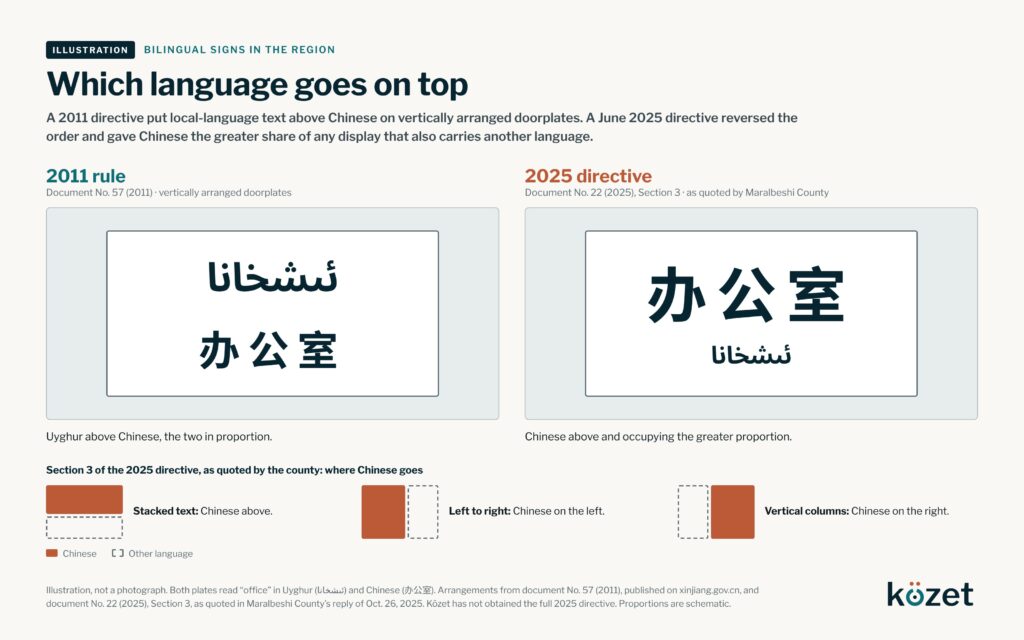
The resident cited a May 9, 2011, directive from the regional government office, the Notice on Further Standardizing the Use of the Two Languages and Scripts, document No. 57 of 2011. It required both scripts, in proportion, on public signs across the region, from shops, hotels and hospitals to schools and places of worship, and set the order for official doorplates and seals: where the two were stacked, the text of “minority languages” went above Chinese; where they ran side by side, Uyghur went on the right and Chinese on the left.
“Now community authorities require Chinese above minority-language text, or simply the removal of minority-language text,” the complainant wrote in Chinese, using the official term.
In its reply the following day, the county identified a newer directive: the Notice on Strengthening the Standardized Management of Language and Script Use in Society, document No. 22 of 2025, issued June 7, 2025.
Quoting Section 3, the county said the directive requires the national common written language to occupy a greater proportion of any display that also carries another language. For text stacked vertically, Chinese must appear above; for text running left to right, Chinese must appear on the left; for text written in vertical columns, Chinese must appear on the right.
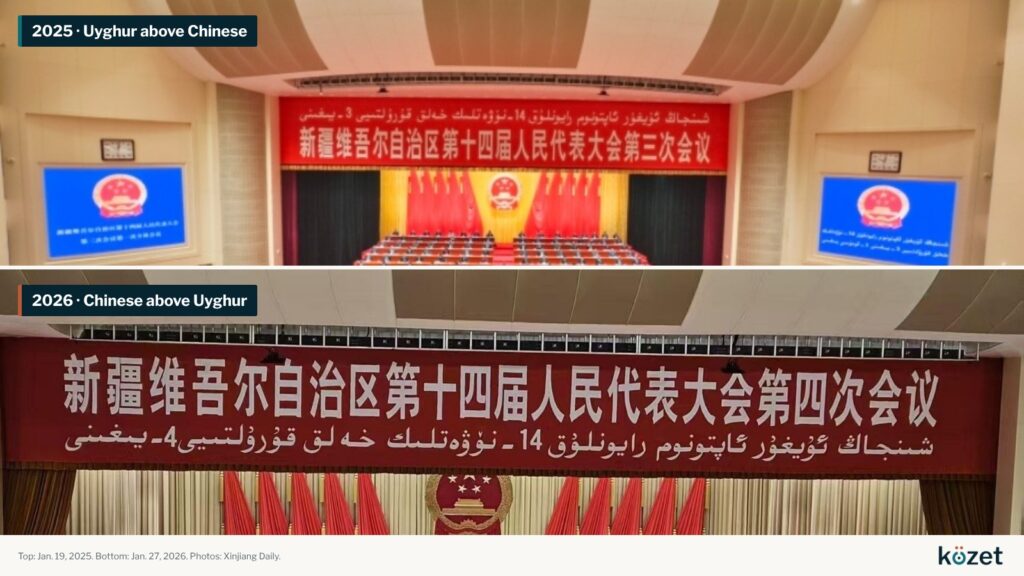
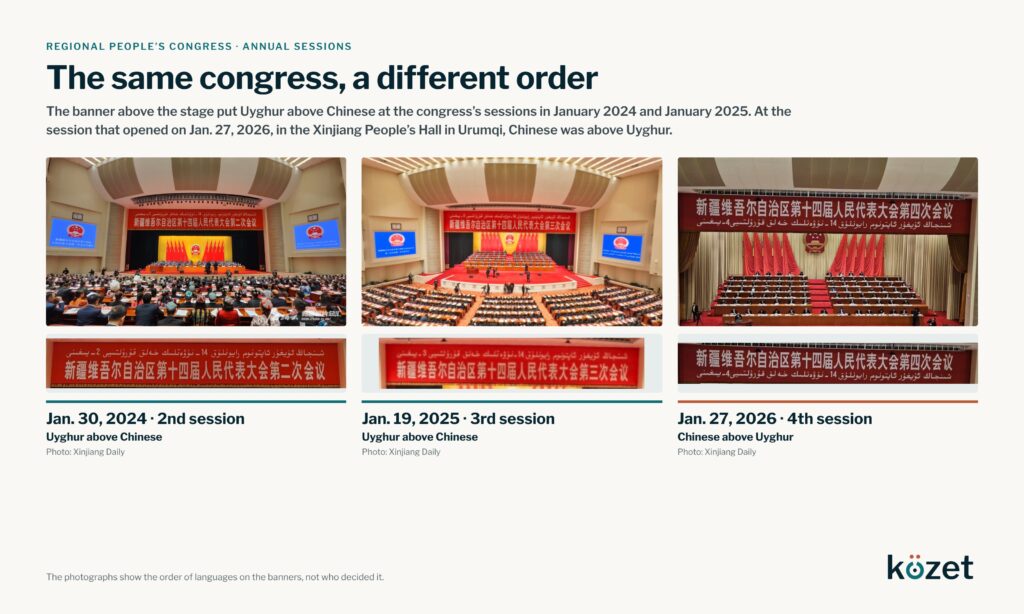
The new order has since appeared at the legislature’s own sessions. The banner above the stage at the regional people’s congress’s sessions put Uyghur above Chinese in January 2024 and January 2025. At the session that opened on January 27, 2026, in the Xinjiang People’s Hall in Urumqi, Chinese was above Uyghur. The 2011 directive had required the banners of important meetings to carry both scripts; the 2026 banner still does, with Chinese on top.
The county also quoted Section 8, under which the directive took effect on issuance and takes precedence over conflicting earlier regional policy documents.
The directive could change the order and size of the two scripts because the 2015 regulation let it. Article 11, after listing the signs, seals, documents and notices that must carry both languages, leaves “color, font, size, arrangement and other standards” to rules set by the regional government. The 2011 directive was that rule; the 2025 directive replaced it.
What a government directive could not do was remove the requirement to use both scripts, which sat in the regulation itself and carried fines for sign-makers who ignored it. Any order to strip local-language text from signs in 2025, as the complainant alleged, would have conflicted with Article 11 as it then stood. The requirement was removed only by the legislature, in the 2026 revision.
The county said its market-regulation department had been assigned to explain the requirements to the complainant by telephone. The reply did not say whether businesses had been told to remove local-language writing.
Government bodies continued to publish the 2015 rules after the directive was issued. Eleven days later, the Urumqi Education Bureau issued inspection standards citing the 2015 regulation’s requirement to use both Chinese and local languages on specified signs, and in August 2025 the Qumul (Hami) city government posted the full 2015 regulation, fines included, on its website. In November 2025, the Urumqi city government’s website still listed the capital’s own 1999 rules as in effect. They require Uyghur above Chinese on stacked plaques and seals, both scripts on street and traffic signs, and fines for offices that do not comply.
National legislation followed
On December 27, 2025, the National People’s Congress Standing Committee revised the Law on the Standard Spoken and Written Chinese Language, effective January 1, 2026. The revised law adds that no organization or individual may obstruct citizens from learning and using the national common language. Its Article 9 protects the freedom of all nationalities to use and develop their own languages, and its Article 10 makes the national common language the language of official business for state organs unless another law provides otherwise.
The Ethnic Unity and Progress Promotion Law, adopted in March 2026 and in force since July 1, requires in its Article 15 that Chinese receive prominence in the positioning and ordering of bilingual public displays. The same article requires that where other laws call for official documents in a “minority” language, the government’s term, both that version and the Chinese one be provided.
Leibold said the national laws and the regional regulation are parts of one political project that predates Xi Jinping’s leadership. “Those national laws gave nationwide legal force to a policy direction that had already been pursued in Xinjiang and other minority regions,” he said. “So I would not describe this as a simple case of Beijing passing a law and Xinjiang subsequently implementing it.”
He said the county’s quotation supports the chronology of the signage rule but does not by itself establish that the region originated the national policy.
Autonomy and who decides
The Regional Ethnic Autonomy Law leaves the choice to the region. Its Article 21 lets the organs of an autonomous area use one or several locally common languages and allows the autonomous nationality’s language to be the principal one; it neither requires that nor declares the languages equal.
The region has never adopted the autonomy regulation to which Article 21 defers; none of China’s five autonomous regions has. Its language regulations of 1993 and 2015 filled that space, and the equal-effect clause of 2015 was the region exercising the latitude national law gives.
The 2026 text, adopted by the same legislature, drops the clause.
The decision was the regional legislature’s, taken within a national framework that had moved in the same direction. That framework narrows the room Article 21 leaves: the revised national language law makes Chinese the language of official business for state organs unless another law provides otherwise, and does not say whether Article 21 counts as such an exception.
Regional legislation in China is drafted and adopted under party leadership; the Legislation Law, as revised in 2023, states in Article 3 that lawmaking must uphold the leadership of the Communist Party, and the region’s party secretary is appointed by the central leadership.
Since the Xinjiang Uyghur Autonomous Region was established on October 1, 1955, one Uyghur has held the top party post: Seypidin Azizi, acting secretary from July 1972 and first secretary from June 1973 until January 1978, when Wang Feng replaced him. Every other party secretary, before and since, has been Han.
The incumbent, Chen Xiaojiang, was appointed on July 1, 2025, weeks after the signage directive was issued under his predecessor, Ma Xingrui. Chen came from the Central United Front Work Department, where he was executive deputy head. Before that he led the National Ethnic Affairs Commission, the first Han official to do so in 66 years. On taking office he said he would keep “forging a strong sense of community for the Chinese nation” as the main line of the region’s work. The revised language regulation names the same goal among its purposes in Article 1, and its Article 5 places language work under the leadership of the Communist Party.
Magnus Fiskesjö, an associate professor of anthropology at Cornell University, told Közet the revision was “a step towards eradicating ethnic identities altogether.” He said the government, which he described as still concerned with international opinion, keeps the rhetoric of ethnic autonomy to “cover up the draconian project of eradicating all such identities.” He said he thought it possible that ethnic autonomy “will soon be cancelled from all laws, and from the Chinese constitution.”
If there were genuine ethnic autonomy, he said, Uyghurs would not allow their children “to be sequestered in boarding schools, or for their historical monuments and holy places to be bulldozed.” That those things are happening, he said, shows “that the promised autonomy is in name only.”
Inner Mongolia made a comparable legal change in 2021, Leibold said, when its language measures made Chinese the working language of state organs and the basic language of instruction and repealed a separate regulation on Mongolian.
Tibet, he said, is moving in the same direction, but he “would want to compare the full body of its current regulations before saying that Xinjiang’s is categorically more restrictive.” “What we can say is that the old principle of territorial-nationality autonomy is being subordinated to a common national language and a common national identity,” he said.
A requirement as old as the region
The requirement that the region’s government work in Uyghur and Chinese is older than its language regulations. It appears in the Organization Regulation of the People’s Congresses and People’s Committees at All Levels of the Xinjiang Uyghur Autonomous Region, which the National People’s Congress Standing Committee approved on July 9, 1956. Mao Zedong promulgated it the same day.
Article 49 provided that “people’s committees at all levels of the Xinjiang Uyghur Autonomous Region and their departments use the Uyghur and Chinese languages in performing their duties.” Article 20 required people’s congresses at every level to meet in Uyghur and Chinese, with translation for delegates of other nationalities. In Articles 20 and 49 the text names Uyghur first and Chinese second. Article 35 required people’s committees to consult the members concerned before deciding matters special to another nationality.
The regulation was published in full in People’s Daily on July 10, 1956. On November 24, 1987, the National People’s Congress Standing Committee listed it among 48 organization regulations of autonomous areas that it classified as no longer applicable, after the 1982 Constitution and new national laws on local government and regional autonomy had changed the framework they were written for.
The practice predates the region. On July 14, 1950, Premier Zhou Enlai instructed the Xinjiang provincial government to issue its official correspondence, notices and case files in both Uyghur and Chinese, according to an article by Xu Xing and Du Kaixin published in June on the website of the Communist Party’s Institute of Party History and Literature.
Governments below the provincial level could choose their languages according to the local population, with provincial approval. Government offices and postal and telecommunications departments were to accept letters and telegrams from citizens in their own languages. Közet has not seen the original instruction.
The requirement was not always met. On December 2, 1956, in a report headlined “Are There Really No Problems?”, Shen Shi, a People’s Daily staff reporter, wrote that Uyghur employees of postal and telecommunications offices in Kashgar Prefecture were receiving instructions in Chinese that they could not understand. The supply and marketing cooperative of Mekit (Maigaiti) County, the report said, had received more than 200 instructions and notices from January to April that year, most of them in Chinese.
The requirement passed into the regional government’s provisional rules of 1988, the language regulation of 1993 and its 2015 revision.
The body that adopted the 2026 revision had already changed its own practice. In May 2018, the standing committee of the regional people’s congress revised its rules of procedure so that its plenary, group and joint-group meetings use the national common language, “with Uyghur interpretation as needed.” Its documents are issued in both scripts. The rule it replaced had required all committee documents in Uyghur and Chinese and interpretation in both languages.
The full people’s congress, which did not vote on the revision, still provides, under rules revised in 2023, for sessions in the national common language and in Uyghur, Kazakh, Mongolian and Kyrgyz, with interpreters.
From “Han” to “national common language”
Every text in that chain until 2015 called the two languages by the names of two nationalities. The 1956 regulation, the 1988 rules and the 1993 regulation all wrote “the Uyghur and Han languages,” in that order.
The character 汉, Han, is the name of the Han nationality, and the standard Chinese it referred to had been defined in those terms since October 1955, when two national conferences in Beijing fixed Putonghua as the formal name of the common language of the Han nationality.
The term “national common language” dates from 2000. Drafting of a national language law had begun in 1997 under a title, the Spoken and Written Language Law, that covered all spoken and written languages. In February 2000, according to the Ministry of Education’s account of the legislation, the National People’s Congress Council of Chairpersons decided that the law would regulate only the national common language, “in view of the special nature of the question of ethnic minority languages,” and the bill was renamed the Law on the National Common Spoken and Written Language, known in official English as the Law on the Standard Spoken and Written Chinese Language.
Adopted on October 31, 2000, and in force from January 1, 2001, it defined the term in Article 2: “the national common spoken and written language referred to in this law is Putonghua and standardized Chinese characters.”
Huang Xing, a scholar at the Chinese Academy of Social Sciences’ Institute of Ethnology and Anthropology, described what had changed in an article the Ministry of Education published on November 22, 2010, for the law’s tenth anniversary. The law, he wrote, had elevated Putonghua, “previously called the common language of the Han nationality,” to the national common language, and the scope of its promotion had accordingly grown from Chinese-dialect areas to the whole country, including the regions where other nationalities’ languages are spoken.
In autonomous areas, he wrote, the national common language and the local language were both in common use, and the two “have equal legal status.”
The region kept the old vocabulary for another 15 years. Its 2002 amendment to the language regulation cited the national law by name in Article 1, yet kept “the Uyghur and Han languages” in Article 7, and in Article 17 still called the standard speech “the Han-language Putonghua in common use nationwide,” which cadres of other nationalities were to learn while Han cadres learned the local languages.
The political direction was set in September 2014, when Xi Jinping told the Central Ethnic Work Conference that the state should both require “ethnic minorities” to learn the national common language and encourage Han residents of autonomous areas to learn local languages.
The 2015 revision made the switch in the region’s law: “Han” disappeared from the regulation, and “national common language” took its place and moved to the front of the sentence.
The schools followed in 2017, when the regional party committee’s education work committee ordered what it called “full coverage” of instruction in the national common language. Official figures put the share of students the government classes as ethnic minorities who were taught in it at 38.7 percent in 2016, 82.8 percent in 2017 and 100 percent by September 2018.
The national law followed on December 27, 2025, when a revision added to Article 2 that the national common language “is the language in common use nationwide as fixed by law,” replaced “promote Putonghua and standardized characters” in Article 3 with “promote and popularize the national common language,” and removed “Chinese language” (汉语文) from the education article. The 2026 regional regulation is written entirely in the new vocabulary.
Signs, schools and speech
The 2015 regulation’s Article 11 requires both Chinese and local-language text on unit names, doorplates, seals, certificates and official documents, and on signs, advertisements, notices and slogans in public places and public services.
Article 16 of the revised regulation makes Chinese the basic written language of such displays and permits locally common languages according to public-service needs. Article 20 sets out Chinese-first requirements for bilingual displays in government activities, public services and commercial services, including the Chinese-above arrangement set by the 2025 directive.
From January 1, the regional regulation will no longer require Uyghur, or any other local language, on the signs its 2015 version covered.
In education, the 2015 regulation calls for Chinese and local-language teaching to proceed together in preschool, primary and secondary bilingual education. The new Article 13 makes Chinese the basic language of education and instruction, requires nationally compiled textbooks under state rules and strengthens Mandarin education from preschool onward.
The regulation also reaches speech. Article 12, after making Chinese the working language of state organs, says social organizations, enterprises, public institutions and public-service employees should take the initiative to use Putonghua when communicating in public places. It does not bar the use of Uyghur.
Some agencies have already adopted the new standards ahead of the law, which takes effect in January. An October 13 report by the regional Department of Transport said the Wuxing Mainline Toll Station, under the Tacheng Highway Development Center in the region’s north, had introduced standardized Mandarin service scripts and Mandarin training for employees the department described as “ethnic minority” staff.
The station added language standards to routine inspections, including reviews of recorded service interactions and checks of station signage. The report tied these measures to the regional government’s notice on standardizing language and script use in society. It did not say employees were barred from speaking Uyghur or other local languages. The department did not respond to written questions.
What remains
Chinese authorities say they promote Mandarin to improve communication, education, employment and national unity. Article 3 of the revised regulation begins by committing the region to promote the national common language comprehensively, then pledges to protect the languages of all nationalities and to respect and guarantee the learning and use of minority languages.
No other article turns that pledge into a requirement. Every duty the regulation attaches to minority languages governs how they may be used: Chinese subtitles on minority-language films and online video (Article 14), conformity with state rules for publications and websites (Articles 15 and 19), translation that follows the prescribed political direction and borrows missing terms from Chinese (Article 24), and Putonghua standards for the translators and editors who work in them (Article 21). None requires an office, school or business to use them. The national common language, by contrast, comes with budgets, training programs, an annual promotion week and a channel for reporting non-standard language use (Articles 7, 10, 22 and 23).
Leibold said the pledge “should be taken seriously as a statement of what the authorities say they intend to do, but read alongside the specific rules that determine where and how languages can be used.” Protection, he said, “is increasingly defined by the Party-state: a language may be preserved and displayed (in a museum, for example) while its role as a medium of education, administration and public authority is narrowed.”
“The practical question is whether Uyghur-speaking citizens can use their language to obtain an education, deal with officials and participate in public life on terms that are meaningful to them,” he said. “A general pledge of protection cannot, on its own, answer that question.”
Fiskesjö said such formulations show “how the Chinese government publicly says one thing and in practice does another.”
National law still recognizes those rights. Article 4 of China’s Constitution guarantees the freedom of all nationalities to use and develop their own spoken and written languages, and Article 121 provides that organs of autonomous government in autonomous areas use the locally common languages in performing their functions.
The revised regulation does not ban Uyghur or any other language.
The revised regional regulation takes effect January 1, 2027. The regional government’s website still lists the May 2011 directive as “valid,” although the county’s 2025 response says conflicting provisions in earlier regional policy documents no longer take precedence.
What Közet could not establish
Közet has not seen the full June 2025 directive and does not know who drafted it, or whether it carried out an earlier decision by central authorities. The regional government office has not answered a request for it.
Közet could not verify the Maralbeshi resident’s account that officials ordered Uyghur text removed from signs, and does not know who decided the order of languages on the 2026 congress banner.
How the regulation will be enforced after January 1, including through the complaints channel in Article 10, is not yet known.
Közet was unable to reach residents of the region who could speak without risk. The voices in this story are those of outside scholars; the record is the government’s own.
How we reported this
Közet compared the 2015 and 2026 texts of the regional Regulation on Spoken and Written Language Work article by article. It checked them against earlier texts: the 1993 regulation as amended in 2002, the 1956 organization regulation as published in People’s Daily and the State Council Gazette, and the rules of procedure of the regional people’s congress and its standing committee as published in the congress’s official gazette. It also reviewed the Uyghur-language pages of Tianshan Net, the regional government’s news portal, and Xinjiang Daily’s photographs of the regional people’s congress’s annual sessions from 2024 to 2026.
The regional government’s 1988 provisional rules were found in a legal database reproduction and have not been authenticated against an official publication. The June 2025 directive is known only from the sections quoted in Maralbeshi County’s published reply to a resident’s complaint. Közet holds a copy of that record and has not obtained the full directive. Government documents cited in this story are linked where they appear.
Közet sent written questions to the regional government office, the Maralbeshi County government and the regional Department of Transport on November 9. None had responded by publication.