
He led the hunt for “two-faced people.” One hundred days later, he was dead
Editor’s note: The Urumqi police report at the center of this story was identified and provided to Közet by the Xinjiang Victims Database, whose founder and curator serves on the board of Uyghur Monitor Inc., the nonprofit that publishes Közet.
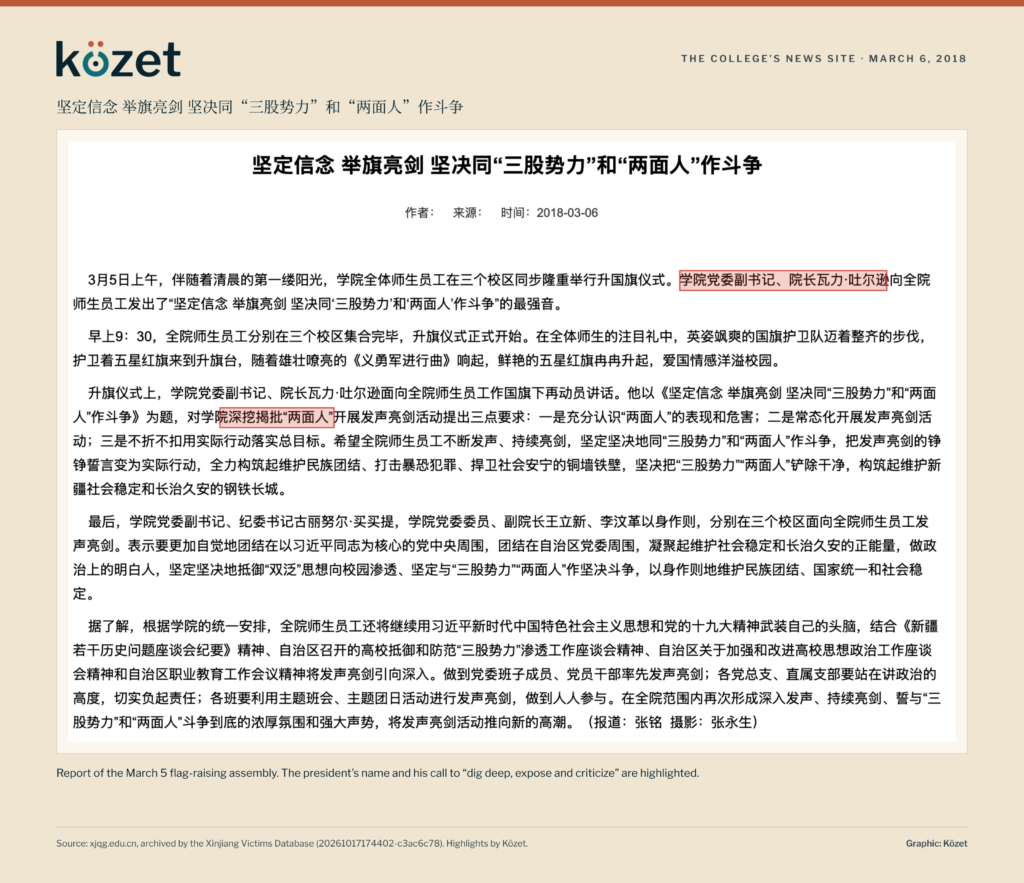
NEW YORK (Közet) – On the morning of Monday, March 5, 2018, at the flag-raising ceremony that opens every school week in China, the president of the Xinjiang Light Industry Vocational Technical College in Urumqi, the capital of the Xinjiang Uyghur Autonomous Region in China’s far west and home to most of the country’s roughly 12 million Uyghurs, stepped forward to deliver what the college’s news site called “the strongest voice.” The college had raised China’s flag at 9:30 on all three of its campuses at once.
Weli Tursun, a Uyghur official who had run the college since 2016, told the assembled students and staff that the school would “dig deep, expose and criticize” the “two-faced people” in its ranks, the party’s term for officials it suspected of public loyalty and private dissent. Everyone would take part, he said, and the party cadres would go first.
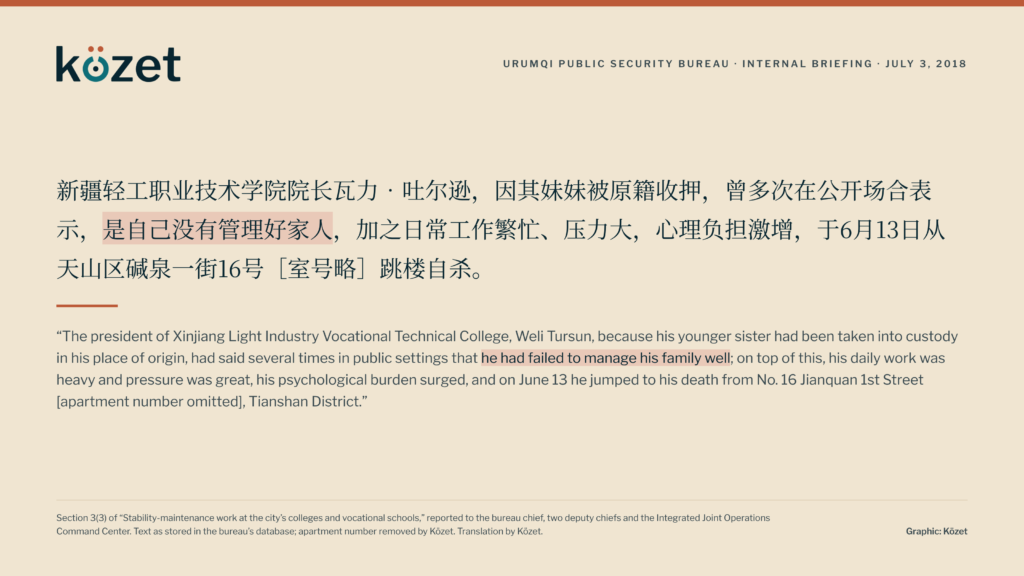
One hundred days later, according to an internal report of the Urumqi Public Security Bureau, he was dead. The report, dated July 3, 2018, gives a reason. His younger sister had been detained in his home area, it says, and he “had said several times in public settings that he had failed to manage his family well.” The police record that on June 13 he jumped to his death from a 15th-floor apartment on Jianquan 1st Street in the city’s Tengri Tagh (Tianshan) district. He was 53. Közet could not independently confirm his death.
The report is a briefing on “stability maintenance” at Urumqi’s 52 colleges and vocational schools, and it describes, in the police’s own words, what that stability was costing in the summer of 2018. It counts the students who were in detention, the students whose relatives were, and the students the police had “labeled.” It lists teachers who had resigned, been fired or been reassigned under a campaign of mandatory self-examination. Weli Tursun’s death occupies one sentence, offered as the third of three “examples” of the “psychological pressure” the campaign was placing on teachers, after a counselor fired for hiding her husband’s detention and a contract teacher removed from the classroom for weak Mandarin.
The report was written while China was telling the world that what it describes did not exist. Six weeks after it was sent, on Aug. 13, 2018, a Chinese official, Hu Lianhe, deputy director of the party’s United Front Work Department, told the United Nations Committee on the Elimination of Racial Discrimination in Geneva that “the argument that one million Uighurs are detained in re-education centres is completely untrue,” while China’s delegation said that “those deceived by religious extremism… shall be assisted by resettlement and re-education,” the BBC reported. The Urumqi police, counting their city’s students for the bureau chief, used a different phrase: 收押(收教), “in custody (taken for education),” with the parenthesis as the police’s own gloss on what education meant. In January 2018, six months before the report, in a story on poverty relief, Xinhua had reported that “government-organized occupational education programs covered 1.26 million people in Kashgar and Hotan” in 2017, two prefectures in the Uyghur-majority south, without saying what the programs were.
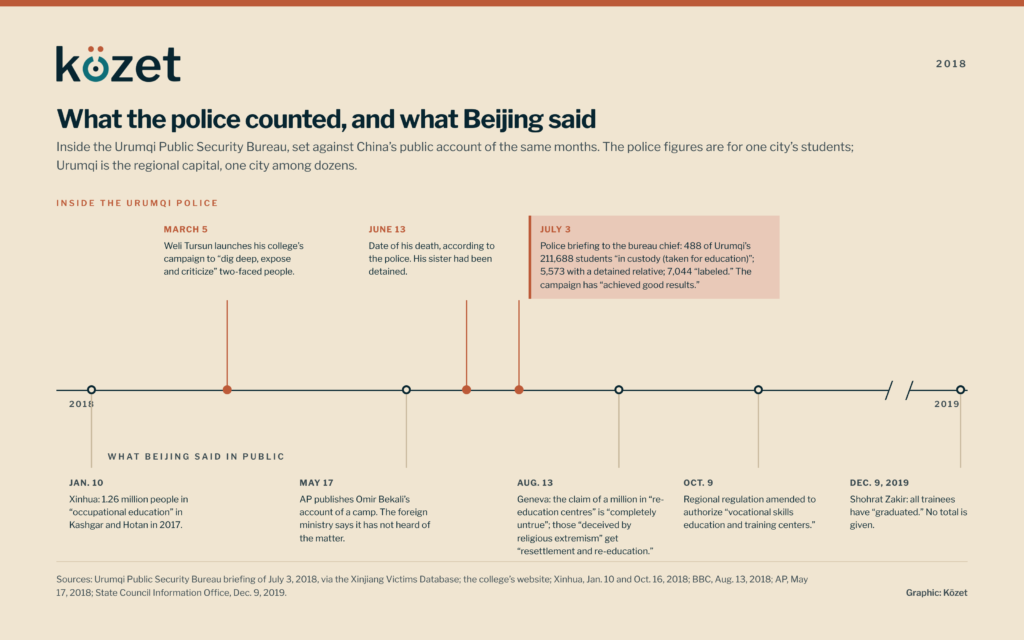
In the eight years since, Beijing’s account of the region has gone through three stages: denial, in Geneva in August 2018; acknowledgment, when the region amended its de-extremification regulation on Oct. 9, 2018, to authorize “vocational skills education and training centers” and its chairman, Shohrat Zakir, gave Xinhua a long defense of them a week later; and completion, when the same official announced in December 2019 that every trainee had “graduated,” without saying how many there had been.
The fourth stage came on Oct. 3 this year, at the foreign ministry’s regular press briefing in Beijing, when a Reuters reporter asked about Starbucks’ opening of two stores in Urumqi. Two days earlier, Rep. John Moolenaar, the Michigan Republican who chairs the U.S. House Select Committee on the Chinese Communist Party, had called Starbucks’ move “a shocking and morally bankrupt decision by a company that prides itself on social responsibility,” in a committee statement that said the China “is committing genocide against Uyghurs and other minorities.” The spokesman, Guo Jiakun, gave the answer Beijing has given since the United States first applied the word genocide in January 2021, and, in substance, since the mass detentions were first reported in 2017. It is also the position Beijing took in August 2022, when the UN human rights office concluded that the extent of arbitrary and discriminatory detention of Uyghurs and other predominantly Muslim groups in the region “may constitute international crimes, in particular crimes against humanity,” an assessment China’s foreign ministry called “invalid and illegal.” “The so-called ‘genocide’ in Xinjiang is a blatant lie,” Guo said, according to the ministry’s published transcript. “This U.S. group is known for vilifying China out of political motives and has absolutely no credibility to speak of. Today’s Xinjiang enjoys social stability, economic prosperity, ethnic unity, and religious harmony.”
The police report is one entry in a vast trove of Urumqi police records that The Intercept reported in January 2021: a 52-gigabyte database from the Urumqi Public Security Bureau, close to 250 million rows of data covering 2017 to 2019, with more than 400,000 internal reports written by officers at precincts, checkpoints and specialized units across the city. The Xinjiang Victims Database, a public record that held 101,418 individual entries as of November 2, the great majority of them people detained at some point since 2017, along with children of detainees and people missing or likely detained, has been reading and translating those reports; it has published 775 of the shorter notes in a searchable archive and 14 of the longer reports, including this one, and provided it to Közet. Together with the college’s own publications, which Közet retrieved from Chinese websites and the database has archived, it allows the last two years of one man’s life to be reconstructed largely from Chinese sources.
The leaks of 2019 and 2022 showed how the campaign against Uyghurs was designed at the top and how the camps were run. This report shows how it was administered in the middle: by the police units that counted students, by the education department that ordered teachers to examine and criticize themselves, and by Uyghur officials like Weli Tursun, who were required to enforce it on their staff and who, in his case, were then judged by the same rule. Of the roughly 212,000 students in the 52 colleges and vocational schools of Urumqi, the regional capital and one city among dozens, the police’s own figures put 1 in 16 in detention, with a detained relative, or under a police “label”; among the non-Han half of the student body, roughly 1 in 8. The count covers only the capital, a city with a Han majority. Közet has found no earlier public record of a serving college president in the region whose death the authorities themselves tied to the campaign.
No obituary, notice or state-media report of his death has been found, and the college’s website gives no account of why its president vanished from its pages after May 2018. The college, the regional education department, the Urumqi Public Security Bureau and the Chinese Embassy in Washington did not respond to written questions. What the documents establish is the path that led to June 13, 2018: a two-year sequence in which an official was required to denounce “two-faced people,” then to hunt for them among his staff, and then was held to account for a detained relative.
The report
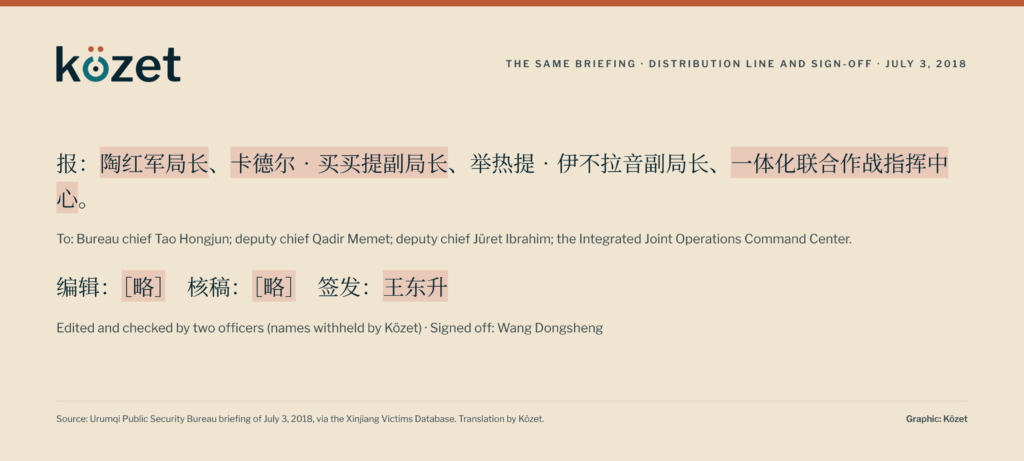
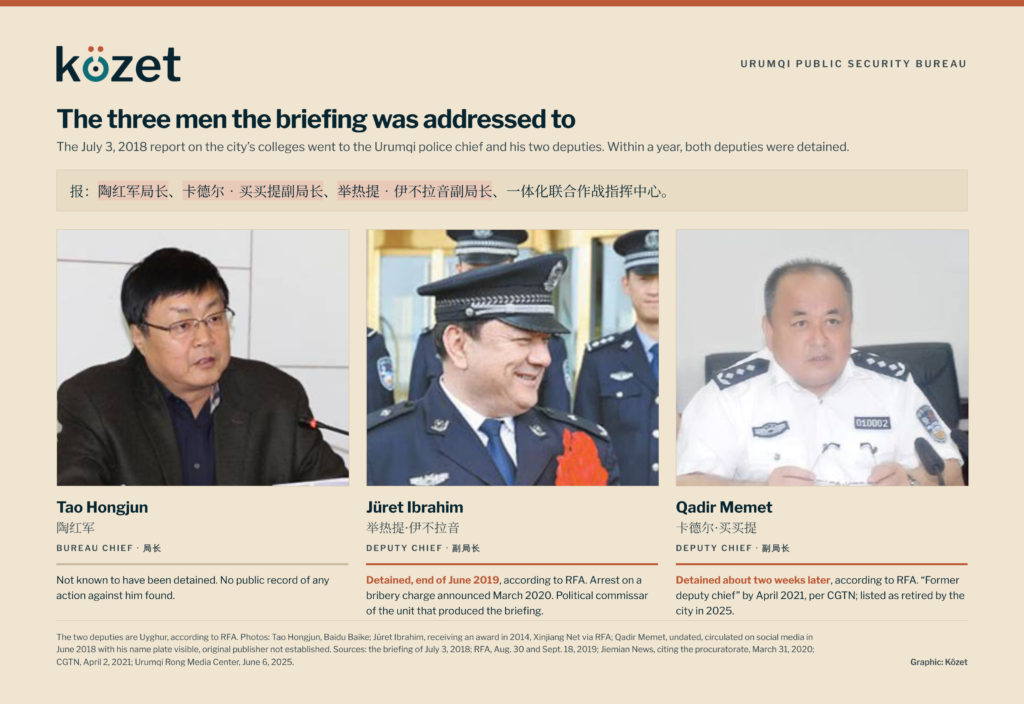
The briefing runs to roughly 3,000 Chinese characters, far longer than the short notes that make up most of the database. It was addressed to the bureau’s chief, Tao Hongjun, two deputy chiefs and the Integrated Joint Operations Command Center, the command post of the Integrated Joint Operations Platform, the data-driven policing system whose role in generating detention lists was described by the International Consortium of Investigative Journalists in its 2019 “China Cables”investigation. The Urumqi report itself was edited, checked and signed off by three officers of the bureau’s Domestic Security Branch (国内安全保卫支队), the unit that handles political and state-security cases, according to personnel records in the same database. The officer who signed it off, Wang Dongsheng, was the branch’s deputy head; other entries instruct officers who encounter people tagged as “security-endangering key persons” to notify him.
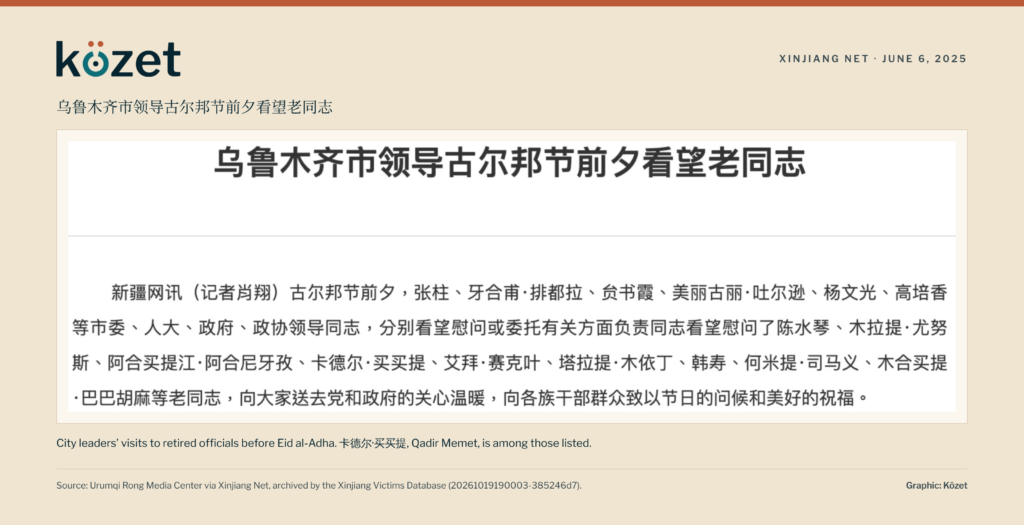
One of the two deputy chiefs it was addressed to, Qadir Memet, described by Radio Free Asia as the highest-ranking Uyghur officer in the city’s police, was himself detained a year later, in the summer of 2019, Radio Free Asia reported at the time; a worker at the bureau’s disciplinary commission told RFA he had not been released and would not say whether the case concerned a “two-faced official.” Közet was told in October that the case against Qadir Memet was ultimately handled as an internal disciplinary matter and that he was demoted and allowed to retire. The account came from a person living outside China who said it had come from a serving officer of the Urumqi police. The person spoke on condition of anonymity, citing fear of reprisal and the need to protect that officer. Közet could not verify it and was unable to reach Qadir Memet. In April 2021 CGTN broadcast an interview with him in a documentary on terrorism in the region, captioned “former deputy chief of Urumqi Public Security Bureau,” in which he recounts a 2014 attack and says, in the broadcaster’s rendering, that “the greatest danger often comes from the enemy within”; the film does not say when the interview was recorded. In June 2025 the city government listed a retired official of that name among the “veteran comrades” its leaders visited before Eid al-Adha.
The other deputy chief the report was addressed to, Jüret Ibrahim, had been detained about two weeks before Qadir Memet, RFA’s Uyghur service reported in September 2019, citing a person with knowledge of the city’s senior officials who said the two cases were connected and that both men “knew too much,” above all about the camps. According to that account, Jüret Ibrahim had disclosed the total number of people then held in “training centers” at a gathering of Uyghur police staff; questioned about it around April 2019, he said he had mentioned the figure only to encourage his subordinates and was let go, then was detained at a second interrogation at the end of June on a charge of divulging state secrets and taken away in handcuffs. A police-station officer told RFA he was being held in a “training center”; other officers confirmed the detention but would not say why. RFA said it could find no firm evidence for the stated reason.
The authorities’ own account, when it came, was different: in March 2020 a notice on the Supreme People’s Procuratorate’s news site, relayed by Jiemian News, said that the Urumqi supervisory commission had completed an investigation of the “former deputy chief” on suspicion of taking bribes and handed the case to prosecutors, and that the Urumqi Railway Transport Procuratorate had approved his arrest on a bribery charge. The notice said the case was still being processed; as of October 2026, Közet has found no court judgment, sentence or other disposition of it. Jüret Ibrahim had sat on the bureau’s party committee since 2014 and served as political commissar of the city’s domestic security police detachment, the same branch whose officers signed off the briefing. Within a year of receiving the briefing, both of the deputy chiefs named on it, the two Uyghurs among its addressees, had themselves been detained.
A party man
Weli Tursun was born in July 1964, according to a biography on Baidu Baike, the Chinese online encyclopedia, which cites government personnel notices. He began work in July 1989 and joined the Communist Party in July 1996. By late 2013 he was deputy director of the regional Light Industry Administration Office, a unit of the economic and information technology commission that supervises the college. On Jan. 31, 2016, a regional personnel round set his rank at deputy department-bureau level (副厅长级). The encyclopedia entry still lists his old post as “current.”
By August 2016 he was in the job. On Aug. 6 that year the college’s WeChat account named him, three times, as “Party committee deputy secretary and president,” chairing a national forum on textile and garment vocational education. The forum was held under a regional program to use the textile industry to “drive employment,” a program later examined by researchers, including the Australian Strategic Policy Institute in 2020, as part of the state-supervised transfer of Uyghur workers into factories. He signed cooperation agreements with mainland universities and companies on stage and spoke on “cultivating high-quality talent to support industry development.”
The man who gave the forum’s closing declaration, Ge Liang, was the college’s party secretary and a former president; the college’s 2016 annual quality report describes him as “former college president, now party secretary.” Under the system set out in the college’s charter, the president works “under the leadership of the party committee,” whose secretary holds the senior post.
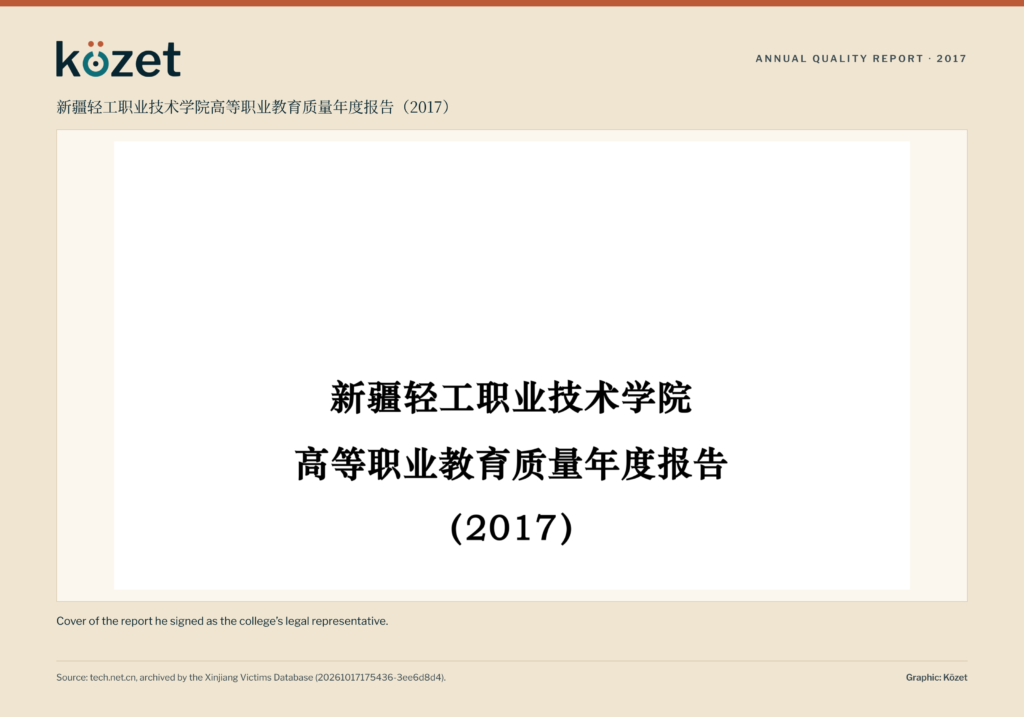
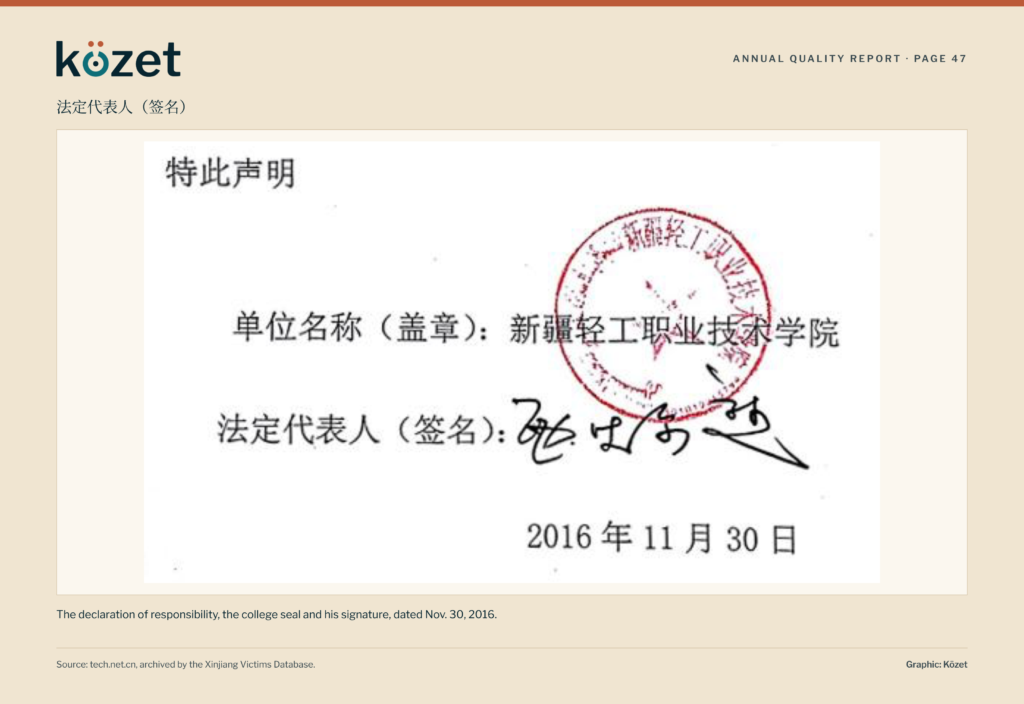
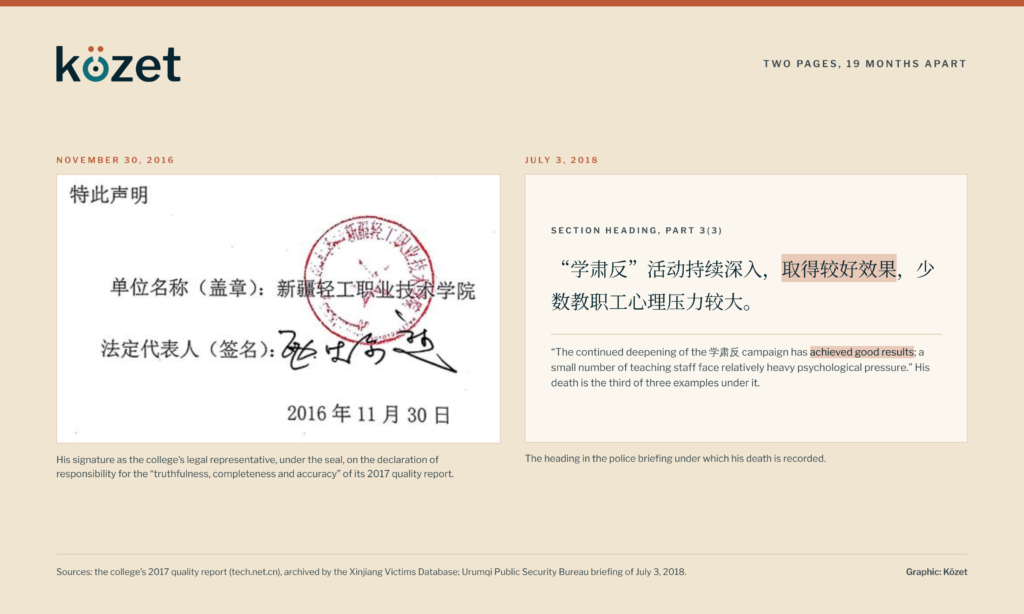
That 2016 report carries Weli Tursun’s signature. Under a declaration accepting responsibility for the “truthfulness, completeness and accuracy” of its contents, he signed as the college’s legal representative on Nov. 30, 2016. The document he signed describes a school of 10,371 higher-vocational students, nearly 44% of them, in the report’s phrase, from “ethnic minorities.” It records that the college had spent more than 9 million yuan, about $1.3 million, to install 1,210 surveillance cameras across its campuses; that it tracked interns by GPS through a mandatory phone app; and that it ran “anti-separatism, anti-infiltration” education at the start and end of every term. Since 2014, it adds, about 120 of the college’s staff had been sent on “visit the people” work teams to Kumkusar township in Makit county, Kashgar prefecture, the village-level cadre deployments that preceded the mass detentions.
“Never be a two-faced person”
Five months later, a statement appeared under his name that defines his public record.
On April 16, 2017, the college’s official WeChat account published a text headed “Set an example, shoulder responsibility, act well,” with Weli Tursun named as author under the platform’s “original” tag and the college’s youth league new-media team credited with producing the post. It was a 发声亮剑 (fasheng liangjian) declaration, “speak out and brandish the sword,” a genre of statement that Uyghur officials across the region published that spring after a model cadre, Obulqasim Mettursun, published a “Letter to Awaken Uyghur Compatriots,” and the regional youth league secretary, Aynur Mehset, published “Five Questions for Uyghur Youth.” Weli Tursun cited both in his opening lines, calling them “deafening, enlightening, sobering.”
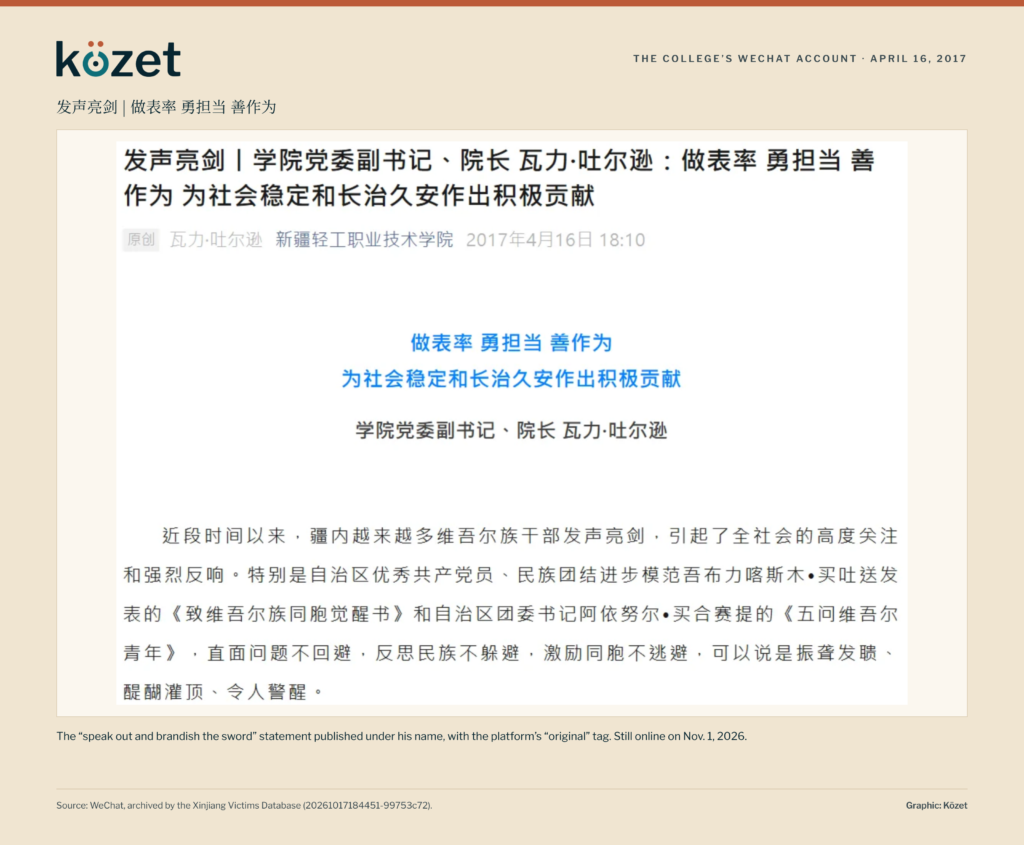
“As a Uyghur leading cadre who grew up under the party’s cultivation and education,” the statement reads, “I deeply recognize that without the Chinese Communist Party there would be no great China, and without the Chinese Communist Party and the great motherland there would be no prosperity and development of our Uyghur people today, no happy life for the Uyghur people, and still less my own growth and progress.”
The statement promised that he would “never be a ‘two-faced person,'” 绝不当”两面人.” It promised that, as president, he would “thoroughly investigate” staff who were “lacking resolve, ambiguous in attitude,” who stored or spread “violent terrorist” videos, who “deliberately did not use the national common language to teach,” or who “criticized the party’s principles and policies.” It promised to build “an unbreakable ‘firewall'” between the “three forces” of separatism, extremism and terrorism and the students. And it set out a rule for himself: “resolutely do not say what should not be said; resolutely do not do what should not be done.”
Whether he wrote those words himself cannot be known. What is certain is that his name and title were on them.
The practice of putting Uyghur voices to the state’s case was carried beyond the region’s borders. On June 25, 2018, twelve days after Weli Tursun’s death, Zulhayat Ismayil, a Uyghur academic who was vice dean of Xinjiang University’s School of Politics and Public Administration, spoke at a side event at the UN Human Rights Council in Geneva titled “The Development and Progress of Human Rights in Xinjiang,” Xinhua reported. Before the autonomous region was founded, she said, women of its non-Han peoples had almost no access to education; now women held 40.4% of urban jobs outside the private sector. The event, organized by the China Society for Human Rights Studies, was the first on Xinjiang that a Chinese nongovernmental organization had held at the UN’s Geneva headquarters, Xinhua said.
What was happening
The college’s statement of April 2017 appeared as the campaign in the region intensified. Chen Quanguo had arrived as party secretary from Tibet in August 2016, and over the following year the detentions grew into a mass system. Internment camps that officials called “vocational skills education and training centers” opened across the region, and the courts sentenced many others to prison. At the same Geneva session in August 2018 at which China’s delegate denied the centers existed, a member of the UN committee, Gay McDougall, said credible reports put the number held at as many as one million.
The purge reached the party’s own Uyghur elite. Tashpolat Tiyip, president of Xinjiang University, disappeared in 2017 and was later reported by Amnesty International to have been sentenced to death with a two-year reprieve. Halmurat Ghopur, president of Xinjiang Medical University, was reported by Radio Free Asia to have received the same sentence. In 2021 the regional government announced that Sattar Sawut, a former director of the education department, had been sentenced to death with reprieve over Uyghur-language textbooks he had approved; officials described him at the time as a “two-faced person.”
Leaked documents have since shown how the system worked from above. In November 2019 The New York Times published more than 400 pages of internal papers showing that the party had investigated more than 12,000 of its members in the region in 2017 for infractions related to the “fight against separatism,” and recounting the purge of Wang Yongzhi, a county party secretary who had quietly released thousands of detainees. The same month ICIJ’s “China Cables” published the operating manual for the camps and the role of the Integrated Joint Operations Platform in selecting people for detention. In May 2022 the “Xinjiang Police Files” added internal photographs, spreadsheets and speeches from the same policing system that produced the Urumqi report.
Weli Tursun’s was not the only death in Urumqi that the police records tie to the campaign. On Dec. 19, 2017, Meryem Ismayil, a 22-year-old law student at Xinjiang University, died by suicide in her dormitory, according to notes in the same Urumqi police database, published in her entry in the Xinjiang Victims Database; the notes name her father’s arrest earlier that year, for which he was sentenced to nine years, and the repeated questioning of her mother as “the factors that caused her to commit suicide.” Qeyser Qeyum, the 55-year-old editor-in-chief of a state-run literary magazine in the city, died by suicide, jumping from the eighth floor of his office building, a former colleague told Radio Free Asia in September 2018; sources told RFA he had been questioned by the authorities a week earlier and, on the day he died, was telephoned and told he would be sent to a camp. Asked whether he had jumped, the head of the political department of the association that published the magazine said, “he did.” RFA did not give the date of his death; one of its sources placed it “not long after” the arrests of editors at the Xinjiang Daily in August 2017. And in March 2018, the month Weli Tursun launched his campaign, a school principal in Korla, Sherep Heyit, was detained at a “condemnation meeting” in his own school, RFA reported, citing a student who was present.
The campaign comes to campus
By the 2017-18 academic year the campaign had a name in the education system: 学肃反 (xue su fan). A 2018 report by Xinjiang University of Finance and Economics spells out the abbreviation: “study the speeches, study the circulars, purge the poison, resist infiltration” (学讲话、学通报、肃流毒、反渗透). The campaign, that university wrote, was a response to “the reality that students influenced by ‘problem textbooks’ are currently studying at the school,” a reference to the Uyghur-language textbooks over which Sattar Sawut was later sentenced. It meant a “comprehensive clean-out” of “classrooms, teaching materials, scholarship, the internet, and ideology and culture.” On May 7, 2018, five weeks before Weli Tursun’s death, the region’s deputy party secretary, Li Pengxin, told officials and teachers that the campaign was a major political task and ordered study sessions on the party circulars condemning Sattar Sawut, Tashpolat Tiyip and Halmurat Ghopur, with “comparative examinations” in which each person was to identify what set them apart from the “two-faced people,” according to a copy of the speech published by Bitter Winter, a magazine that covers religious freedom in China.
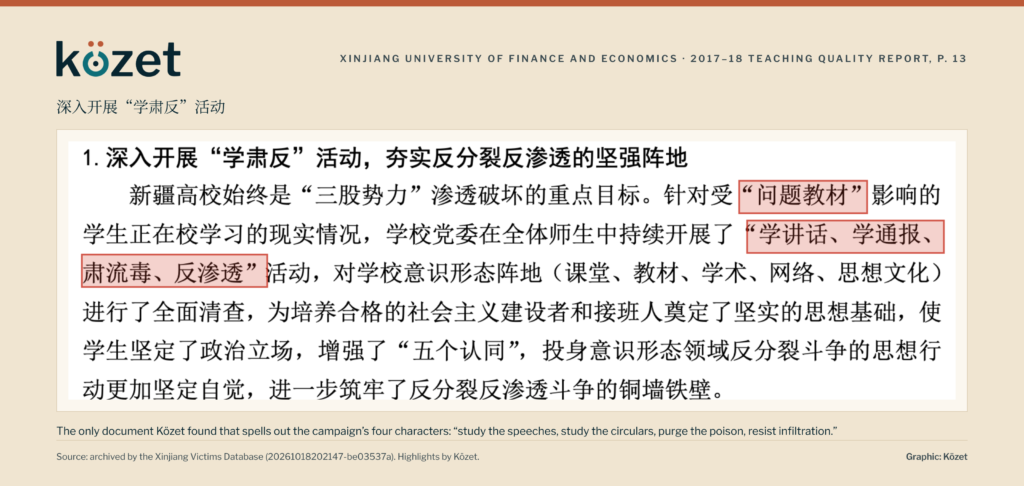
The Urumqi police report describes how the campaign worked on staff. On the orders of the regional education department, every member of staff at every college was required to “repeatedly compare and examine” themselves, to “review their participation in religious activities since starting work,” and to “self-criticize the motives and purposes” of that participation. Most teachers who had attended a nezir, the Uyghur funerary meal, or a circumcision ceremony for a son, the report says, “did not know whether they had already broken the rules.” Every paper a teacher had published and every book was reread. Teachers, it adds, worried about “the content they had written or cited,” and “about whether relatives suspected of participating in endangering-security activities would have a bad effect on themselves.”
The college’s own news pages show the mechanism in operation. On Jan. 3, 2018, the second day of its end-of-semester “concentrated education,” Weli Tursun and a vice president, Guo Jiang, sat in the audience as Ma Pinyan, a researcher at the regional academy of social sciences, lectured the staff on “several prominent problems in the ideological field,” including “the national education problems of recent years.” That morning, the article says, every staff member had given a “statement of position” in a party-branch meeting, while a three-team inspection group checked each branch’s discussions and reported the results the same day.
On Feb. 26, 2018, the first day of the spring term, he gave the flag-raising address, speaking, the college’s reporter wrote, “with deep feeling.” A week later, on March 5, the same reporter and photographer recorded him launching the “two-faced people” campaign from the same podium. His three demands were that the whole college “fully recognize the manifestations and harm of ‘two-faced people,'” that “speak out and brandish the sword” become a routine practice, and that the “overall goal” of stability be met “without discount.” Party committee members would speak first, then every branch, then every class, “so that everyone participates.” The vice presidents Wang Lixin and Li Wenge and the discipline inspection secretary, Gulnur Memet, gave their own declarations the same morning. A college summary published May 2 says the campaign ran under a written implementation plan, with a second round of staff declarations on March 23 in every party branch, at which staff expressed, in the college’s words, “the firm resolve to draw a clear line from ‘two-faced people,'” on the principle of “top down, each level performing for the level above and leading the level below.”
Five days later he was in the field, inspecting the college’s admissions interviews at four sites in Urumqi, Ili, Aksu and Kashgar, where 5,484 applicants were competing for 1,200 places. He chaired the admissions leadership group. The police report, written four months later, notes that vocational schools in the city had that year begun asking neighborhood committees and police stations to vet applicants, and were turning away any student with a detained relative or a “label.” The college’s article does not say whether it did so.
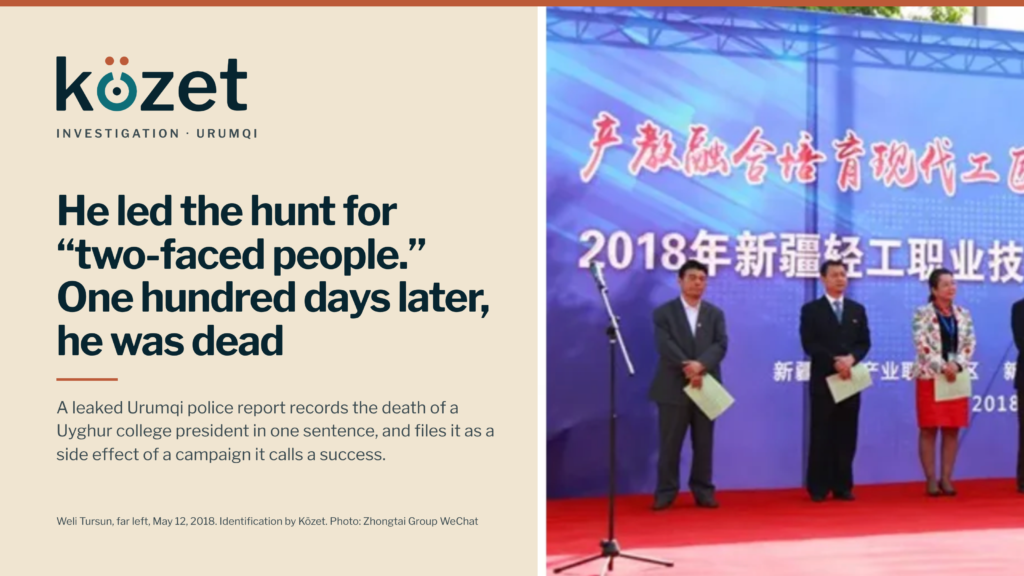
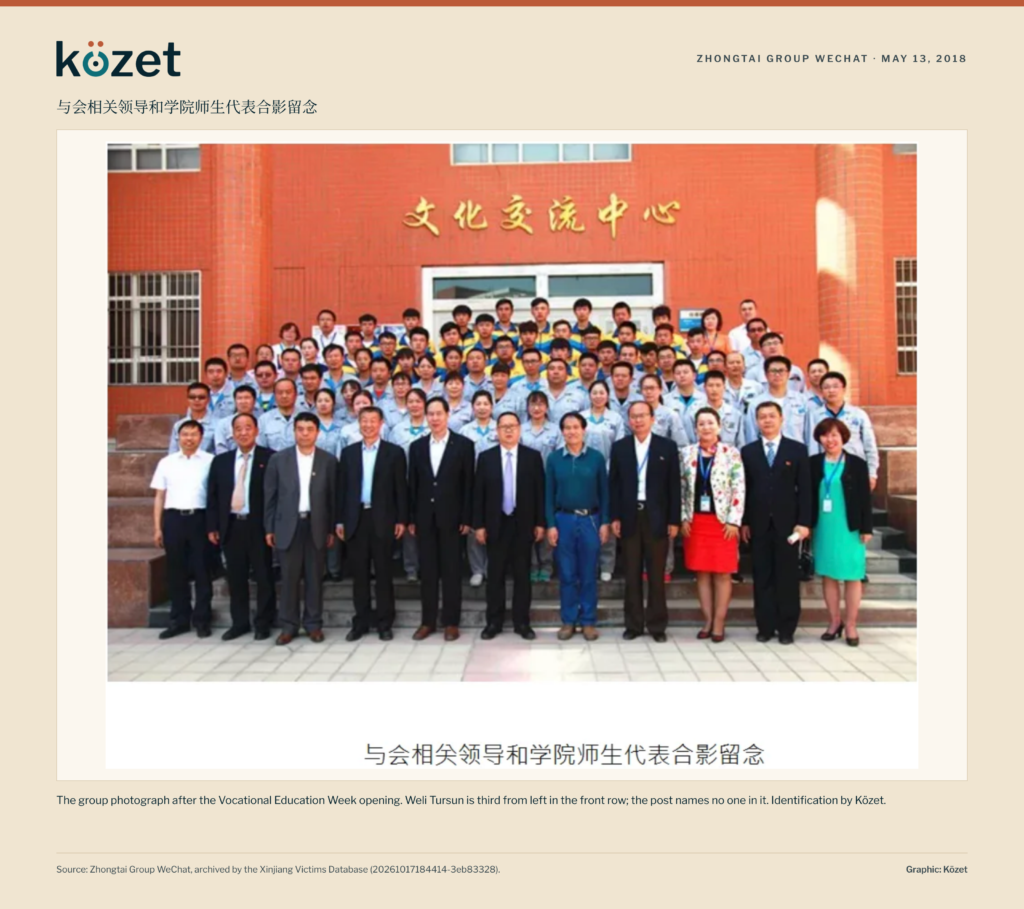
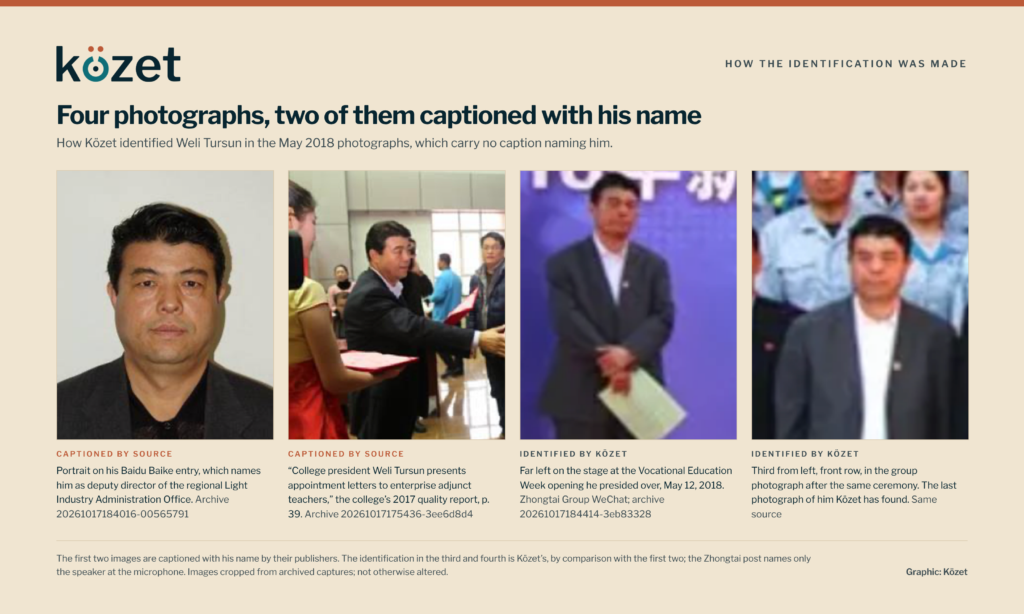
On May 12, 2018, he chaired the opening ceremony of the college’s Vocational Education Week, hosting Xie Qing, a deputy director of the regional economic and information technology commission, and a delegation from Zhongtai Group, a state-owned chemicals conglomerate. A post on Zhongtai’s WeChat account the next day names him as presiding and shows the leaders and students posing for a group photograph. It is the last public record of him that Közet has found.
June 13
The police report places his death on June 13, 2018, at a residential address in central Urumqi.
“The president of Xinjiang Light Industry Vocational Technical College, Weli Tursun, because his younger sister had been taken into custody in his place of origin, had said several times in public settings that he had failed to manage his family well; on top of this, his daily work was heavy and pressure was great, his psychological burden surged, and on June 13 he jumped to his death.”
Three things in that sentence stand out. The first is the phrase 没有管理好家人, “failed to manage his family well.” In party usage it describes a cadre held responsible for the conduct of relatives. Under the campaign he had launched, a detained relative counted against an official’s loyalty. The report does not name his sister, say where she was held, or say why.
The second is that the report records him saying this “several times in public settings.” None of those statements appears on the college’s website or WeChat accounts, and Közet could not establish where they were made. The college’s own articles describe closed party-branch sessions in which every staff member was required to speak and inspectors took notes.
The third is that the police present his death as a cost of a campaign they call a success. The section is headed: “The continued deepening of the 学肃反 campaign has achieved good results; a small number of teaching staff face relatively heavy psychological pressure.”
The report’s account of the cause of death is the police’s framing. Its term, 跳楼自杀, is the standard police formula for a suicide of the kind the quoted sentence describes. Közet has no independent evidence of the circumstances and has not been able to reach his family. His sister’s identity could not be established. Weli Tursun now has an entry in the Xinjiang Victims Database, No. 101402, added after this report came to light.
The numbers behind one sentence
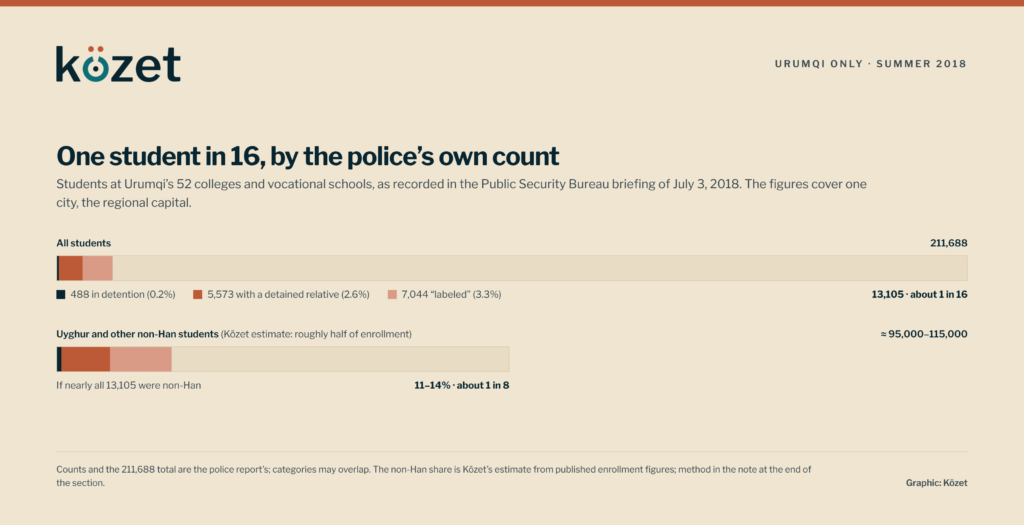
The same report puts figures on what the city’s students were living through in the summer of 2018. Of 211,688 students at the capital’s 52 colleges and vocational schools, 488 were themselves in detention, 5,573 had a detained relative, and 7,044 had been “labeled,” a term the report does not define: together about 6% of the student body, or roughly 1 student in 16, before any overlap between the categories is accounted for. The report gives no breakdown by ethnicity. Han students were unlikely to be in any of the three groups: the detention campaign targeted Uyghurs and other Turkic Muslim peoples of the region, and Han residents of the region were detained only in particular cases, such as Falun Gong practitioners, petitioners and dissidents. Among Uyghur and other non-Han students, who made up roughly half of enrollment at the Urumqi institutions whose figures are public, the rate would have been about twice as high, on the order of 1 student in 8.
Managing a single such student required filling out more than 30 kinds of forms. Internship providers and employers were refusing to take them, and some, the report says, had extended the refusal to all non-Han students, treating them differently from “Chinese-language-track” students. Students from the south were afraid to go home for the summer, because going home could mean detention; the police complain that they were renting rooms in Urumqi instead. Teachers who telephoned the students they were assigned to monitor were being summoned by neighborhood committees to report on their own thinking. Seven counselors at one campus of Xinjiang Normal University, five Han, one Hui and one Uyghur, had resigned over it.
Colleges, the report notes with approval, had bought “Anti-Terror Sharp Sword,” a software tool, to scan the phones and computers of staff and students for banned religious content. The same tool appears throughout the wider database: The Intercept found that in a single week police in one Urumqi subdistrict, Qidaowan, had used it to inspect 2,057 people’s phones. The police, for their part, were deploying “plainclothes squads” and “secret forces” on campus to detect “abnormal thought fluctuations” and “abnormal emotional reactions.”
The report does not evaluate the detentions; it records them, in its opening section, alongside the number of campuses and the size of the student body. Its one-line verdict on the city’s colleges is that “teaching is in good order, the thinking of staff and students is relatively stable, but certain risks and hidden dangers remain.” Every risk it then lists is a risk to the state: students with detained relatives who cannot find work and are “easily pushed to the opposite side,” teachers who quit, graduates who slip out of control when they leave. Its recommendations do not question any of this. They ask the city’s political-legal committee to standardize the forms and reduce their number. No figure has ever been published for what became of the 488 students the report counts in custody, the 5,573 with a detained relative or the 7,044 under a “label”; the December 2019 announcement that all trainees had graduated came with no accounting.
Note on the estimate: The police report gives no ethnic breakdown. Published figures put the non-Han share of enrollment at 52.7% at Xinjiang University (2016–17 quality report), 43.8% at the Light Industry college in 2016, 44% at five vocational colleges in a World Bank project in 2013, and 36.3% of all the region’s higher-education graduates from 1951 to 2020, according to the State Council’s 2021 white paper. On a 45 to 55% bracket, Urumqi’s 211,688 students include 95,000 to 115,000 non-Han students; if nearly all of the 13,105 students in the three categories were non-Han, the rate among them is 11 to 14%, between 1 in 7 and 1 in 9. The 1-in-16 figure for the whole student body is the police’s own.
What was left
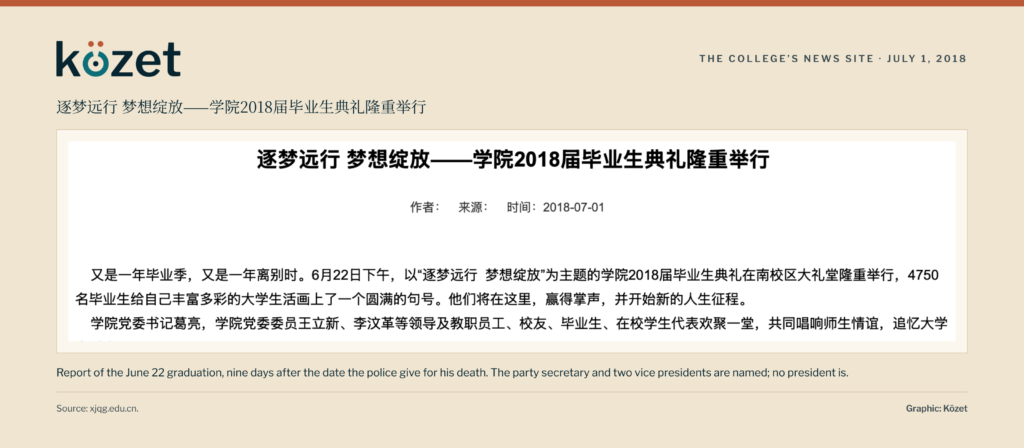
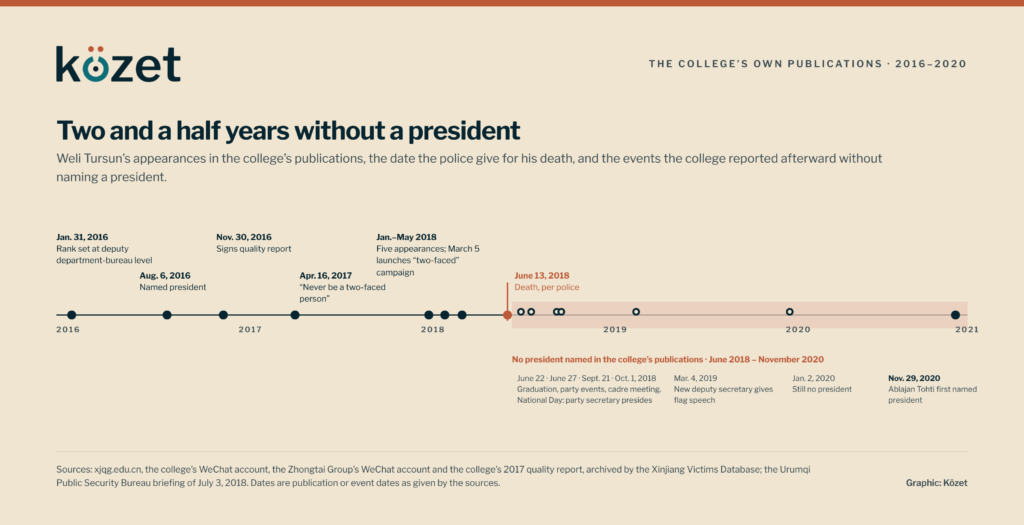
The college’s website records what happened next without saying it. On June 22, 2018, nine days after the date the police give for his death, the graduation ceremony was addressed by the party secretary, Ge Liang, and presided over by a vice president. The president’s name does not appear. It does not appear at the party anniversary events of June 27, at the September cadre meeting where officials from the regional economic and information technology commission read out a notice appointing and removing 27 cadres, or at the National Day flag-raising on Oct. 1. The last article on the college’s site to name Weli Tursun is a summary of the spring “speak out and brandish the sword” campaign, published May 2, 2018, which still calls him president.
In March 2019 a new deputy party secretary, Ablajan Tohti, gave the spring flag speech; he was not named as president until November 2020. For roughly two and a half years the college published its news under a leadership list with no president on it. Gulnur Memet, the discipline inspection secretary who spoke alongside Weli Tursun on March 5, 2018, remained in post through at least 2021. Ge Liang was replaced as party secretary by August 2021.
In May 2026 the Ministry of Education approved the college’s absorption into a new institution, the Xinjiang Industry Vocational Technical University, whose 2026 admissions charter lists the Light Industry college as its “former name.” Its current president is Su Zhi. Yang Qingxiang, the vice president appointed at the September 2018 cadre meeting, served as president in 2025 and is now the deputy party secretary. Guo Jiang, who attended the January 2018 lecture with Weli Tursun, is still a vice president.
The April 2017 statement published under Weli Tursun’s name is still online on the college’s WeChat account, as is the March 2018 article on his campaign against “two-faced people.”
How we reported this
The document. The Urumqi Public Security Bureau report of July 3, 2018 is a text record from the Urumqi police database that The Intercept obtained and reported on in January 2021. It is reproduced here as stored, including its reporting line and sign-off credits. The Xinjiang Victims Database, which holds the data and identified this report, has published its full text in Chinese with an English translation; the translations in this story are Közet’s. On authenticity, the database has identified around 100 individuals whose detention details in these police records are corroborated by independent sources, among them relatives’ testimony and court records, and has listed those cases publicly. Közet has not separately authenticated this entry; its internal details, including the bureau chief’s name, the 学肃反 campaign and the “Anti-Terror Sharp Sword” software, are consistent with the public record.
What rests on one source. The date and cause of Weli Tursun’s death, and his sister’s detention, come from the police report alone. The death is corroborated indirectly by the college’s own record: he is named as president on May 2, 2018, and never again, and the post stays empty in the college’s published leadership lists until November 2020. The sister’s name, place of detention and the reason for it could not be established. A search of the 777 Urumqi police notes the database has published, for his name, the college and the street, found no other report.
Identification. No source states that the Baidu Baike biography is the same man. Közet’s match rests on the identical name, 瓦力·吐尔逊; the same supervising body over his old office and the college; a rank set in January 2016 consistent with a college presidency seven months later; and the portrait on the entry, which matches the man the college’s 2017 report captions as “college president Weli Tursun.” In the May 2018 photographs, where the Zhongtai Group names only the speaker, Közet identified him by comparison with the two captioned images; the four are shown side by side so readers can judge. Both identifications are Közet’s.
Other sourcing. Every fact about Weli Tursun’s career comes from documents published by the college, the Zhongtai Group, the national vocational-education reporting platform and Baidu Baike, each archived by the Xinjiang Victims Database in October 2026. The account that Qadir Memet’s case ended in demotion and retirement is secondhand, from one source relaying what that person said a serving officer had told them; Közet was told more specific allegations and has not published them. The May 7, 2018 speech by Li Pengxin is reported by Bitter Winter from a document it said it obtained; Közet has not seen it.
Requests for comment. Közet sent written questions to the college, the regional education department, the Urumqi Public Security Bureau and the Chinese Embassy in Washington on Oct. 20, 2026, with a deadline of Oct. 22. None had responded as of Nov. 2. The individual officials named in this story are identified from documents published by their own institutions or by the police; Közet had no means of reaching them directly, and its questions went to the institutions.
What Közet could not establish: who ran the college before Ablajan Tohti was named president in November 2020 and why the post stayed vacant; whether the college vetted applicants by family detention in 2018; the text of the January 2016 appointment notice; any account from a relative or colleague.