Uyghur actor Hoshur Seley wins China’s Golden Rooster Award for best supporting actor
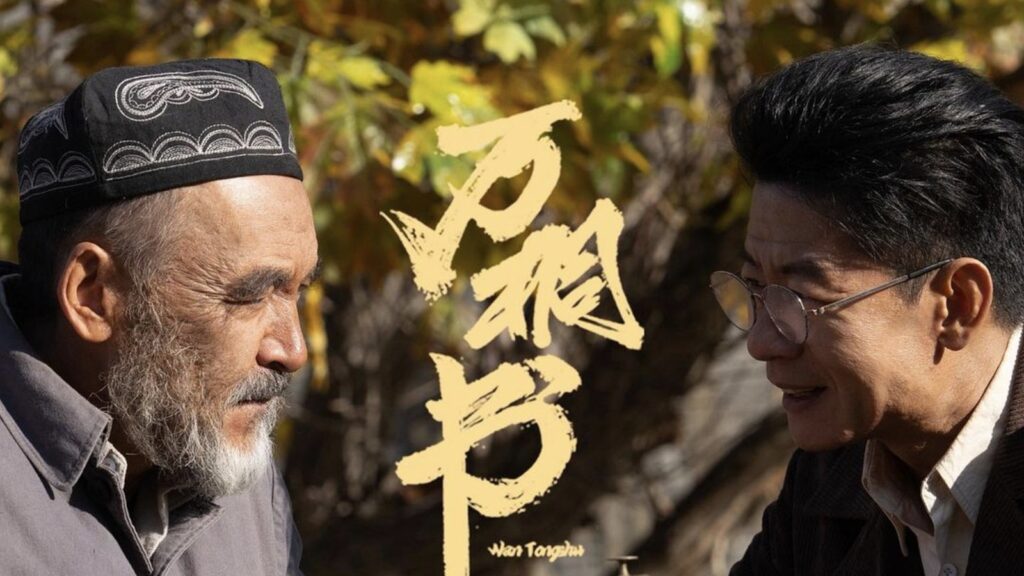
NEW YORK — Uyghur actor Hoshur Seley, known to Uyghur audiences as Hoshur Qari, won best supporting actor at China’s 39th Golden Rooster Awards on Tuesday for playing the Uyghur musician Turdi Akhun in “Wan Tongshu,” a historical drama about the recording of the Twelve Muqams.
Seley, whose name is written 吾守尔·赛来 in Chinese, received the award at a ceremony in Xiamen, in southeastern China’s Fujian province. The Golden Rooster Awards, first given in 1981, are presented by the China Film Association.
Accepting the award, Seley thanked the propaganda department of the Xinjiang Uyghur Autonomous Region Communist Party committee and the state-owned Tengri Tagh (Tianshan) Film Studio.
“I thank the Xinjiang regional Party committee’s propaganda department and Tengri Tagh Film Studio for giving me such a wonderful and valuable opportunity,” he said, according to a publicly available video of the ceremony.
Seley also thanked the film’s director, Shirzat Yakup, and his alma mater, Beijing’s Central Academy of Drama.
“Since graduating from the Central Academy of Drama, winning a Golden Rooster has always been my dream. Today, my dream has come true,” he said, according to the Chinese news outlet The Paper.
He said the honor was not his alone and belonged to all the staff of the studio, The Paper reported.
“I will continue working hard and devote myself to telling Xinjiang’s stories well,” he said.
The film was organized and planned by the regional party committee’s propaganda department and produced by the studio, according to the state-run China News Service.
At an April 18 seminar in Beijing co-hosted by the propaganda department, Lu Liang, deputy director of the China Film Archive, said the film was important for “forging a strong sense of community for the Chinese nation,” Beijing News reported.
Directed by Shirzat Yakup, “Wan Tongshu” follows the Chinese music researcher Wan Tongshu and his wife, Lian Xiaomei, who traveled to the Uyghur region in the early 1950s and worked with Turdi Akhun to record, transcribe and preserve the Twelve Muqams.
Turdi Akhun was at the time the only folk musician able to sing the complete Twelve Muqams, according to the Chinese trade newspaper China Film News.
The Twelve Muqams combine music, poetry, song and dance, passed down through generations of performers. UNESCO proclaimed the Uyghur Muqam a Masterpiece of the Oral and Intangible Heritage of Humanity in 2005.
The film opened in the Uyghur region on April 20 and was released nationwide on April 30, China Film News reported.
Seley spent nearly a year preparing for the role and lost 15 kilograms, or about 33 pounds, over two months to resemble the aging musician, according to a Nov. 6 report by China Film Report. He also practiced the satar, a Uyghur bowed string instrument, and studied Muqam singing techniques.
The Golden Rooster jury said Seley used tightly restrained body language and subtle changes in his eyes to show the musician’s path from passing on the Twelve Muqams to entrusting them to others, according to The Paper.
Seley was born in 1964 in the Kashgar, in the south of the Xinjiang Uyghur Autonomous Region in China’s far west. He graduated from the Central Academy of Drama in 1986.
He has performed in theater, comedy, television and film and holds China’s national first-class actor designation, according to Chinese film-industry biographies. His credits include the television drama “Veterans of the Desert” (Shahai Laobing).
Seley was among five nominees for best supporting actor, alongside Wang Chuanjun for “Dead to Rights,” Bai Ke for “Magic Cube Lady,” Ci Sha for “The Shadow’s Edge” and Shao Feng for “Midang.”
“Wan Tongshu” also won the Golden Rooster Award for best music, given to composer Gao Xiaoyang.