Turkey advertises Xinjiang government scholarships as Beijing denounces its Turkic-world teaching materials
WASHINGTON — Turkey’s Ministry of National Education has advertised scholarships from the government of the Xinjiang Uyghur Autonomous Region for Turkish students, less than two weeks after Chinese state media denounced new Turkish teaching materials for placing the region in a Turkic world.
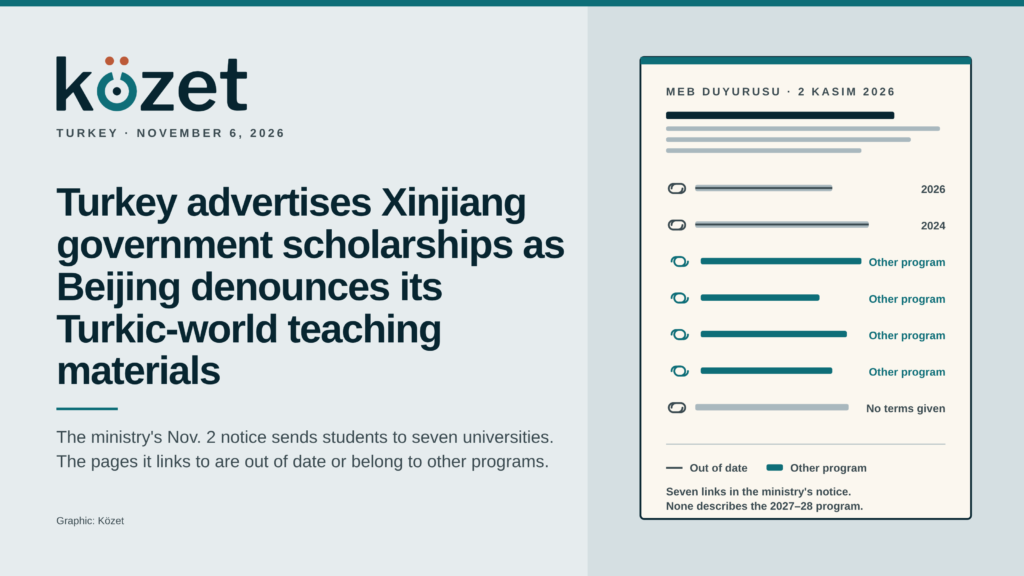
The Nov. 2 notice, carried on the ministry’s foreign scholarships page, says the regional government has allocated undergraduate, master’s and doctoral scholarships for Turkish students for the 2027–2028 academic year at seven universities in the region, and tells applicants to contact the universities directly.
It gives no number of places and no deadline. The ministry says it only announces such foreign scholarships and takes no responsibility for selection.
None of the seven pages it links to describes the 2027–2028 program. Two are for the same scholarship but out of date: Xinjiang University’s brochure is for the 2026 intake, with a May 31, 2026 deadline, and Xinjiang Normal University’s is from January 2024.
Four lead to a different scholarship, funded by the central government rather than the region. The Xinjiang University of Finance and Economics page is a 2026 Chinese Government Scholarship notice open only to citizens of Kazakhstan, Kyrgyzstan, Tajikistan, Turkmenistan and Uzbekistan; it closed on April 7. Kashgar University’s is a February 2026 notice for the same central-government program.
Shihezi University’s page is a news item announcing 10 “Silk Road” postgraduate places for the same five countries, with no application instructions. Xinjiang Medical University’s is a central-government notice from January 2024; the university’s current scholarship page names the regional scholarship but offers only a WeChat QR code.
The seventh, Xinjiang Agricultural University’s general admissions rules from March 2026, mentions the regional scholarship without terms for 2027–2028.
Xinjiang University describes the regional scholarship as a program for “neighboring countries” run on behalf of the regional education department, with priority for students of Confucius Institutes and Chinese language centers. It waives tuition and campus housing and pays 1,000 yuan a month to undergraduates, 1,220 to master’s students and 1,500 to doctoral students. The central-government scholarship at Finance and Economics pays 2,500, 3,000 and 3,500 yuan.
The language requirements do not match either. Under the ministry’s notice, undergraduate applicants need a score on the China Scholastic Competency Assessment, the entrance test for international undergraduates in China, and graduate applicants need at least HSK Level 4 in Chinese. The Xinjiang University brochure asks for HSK 5 for Chinese-taught graduate programs.
The regional government has offered the scholarship to neighboring countries since at least 2024, when Kazakhstan’s Bolashak center announced 50 places and Kyrgyz media reported 125. The notice does not say whether Turkish students have been eligible before, and the ministry did not respond to a question from Közet about that.
The notice follows an online confrontation that began on Oct. 16, when a Turkish user on X described meeting a Uyghur woman from the region who, asked whether she considered herself Turkic, said she was Chinese. “How are you Chinese? Return to your roots,” the user wrote in Turkish. Közet could not verify the encounter. The post had drawn more than 2.2 million views as of Nov. 6, and the argument between Turkish and Chinese users spread to Weibo and other platforms, taking in Uyghur identity, history and the two countries’ economies.
The dispute moved to two sets of teaching materials Turkey introduced in September, “Hakan and Bilge’s Journey through the Turkic World” (Hakan ve Bilge’nin Türk Dünyası Yolculuğu) for younger students and the “Cultural Atlas of the Turkic World” (Türk Dünyası Kültür Atlası) for high schools. The ministry’s Aug. 30 announcement calls them materials distributed alongside textbooks; Education Minister Yusuf Tekin told TRT Haber in late October that the atlas “is not a textbook.” The materials use “Turkistan” (Türkistan in Turkish) in place of “Central Asia,” following a curriculum change the ministry documented in April 2024.
On Oct. 22 the state-run China News Service published an article headlined “Turkey’s new teaching materials fabricate Xinjiang’s history” and posted it on its X account, tagged with the name of a WeChat account, Xiaoyuangui. It said the materials put parts of Xinjiang, Gansu and Qinghai inside a “fictional” Turkistan and “use education to export geopolitical ambitions.”
Ming Pao described Xiaoyuangui as suspected of operating under the Communist Party’s United Front Work Department; Közet has not established the account’s affiliation, and has not seen the atlas’s maps.
The ministry describes the atlas as a journey along 15 routes of the Turkic world, beginning with a map from the Dīwān Lughāt al-Turk, the 11th-century compendium of Turkic languages by Mahmud al-Kashgari. He was a scholar of the Kara-Khanid khanate, a Turkic state centered on Kashgar, today a city in the south of the Xinjiang Uyghur Autonomous Region in China’s far west, and on the Tengri Tagh (Tian Shan) mountains. He compiled the work in Arabic in Baghdad around 1072–74 and drew in it the earliest known Turkic map of the world, with the Turkic lands at its center; his tomb stands outside Kashgar. Tekin’s foreword to the atlas says borders on maps cannot sever bonds between peoples.
Tekin has defended the term. At a meeting of Organization of Turkic States education ministers in Kazakhstan on June 8, he said the curriculum had dropped “Central Asia” for “Turkistan,” according to the ministry’s account, and in a TRT Haber interview on June 25 he called “Central Asia” a Western-centered term. Közet found no ministry response to the Chinese criticism.
The usage reaches the top of the Turkish state. At the Istanbul summit in November 2021 that renamed the Turkic Council the Organization of Turkic States, President Recep Tayyip Erdoğan said “the geography of Turkistan, a cradle of civilization for thousands of years, will once again become a center of attraction and enlightenment for all humanity.”
Ankara and Beijing have meanwhile drawn closer. When Chinese Foreign Minister Wang Yi met Turkish Foreign Minister Hakan Fidan in Baku on Oct. 15, Fidan said Turkey would adhere to the one-China principle and never allow its territory to be used for activities endangering China’s security, according to the Chinese Foreign Ministry’s readout. Turkey’s Foreign Ministry confirmed the meeting without an account of what was said.
Turkey hosts one of the largest Uyghur communities outside Central Asia, an estimated 50,000 people, according to Human Rights Watch in a November 2025 report.
Beginning in 2017, Chinese authorities held an estimated million or more Uyghurs and other Turkic Muslims in internment camps and prisons in the region, according to U.N. human rights experts and researchers. Many camp detainees were later moved into the formal prison system, and a 2025 study by the U.S. Holocaust Memorial Museum estimated that more than half a million remain in prisons or extrajudicial detention.
The United States declared the campaign a genocide in January 2021, a finding several parliaments have echoed; Beijing rejects the term and says the facilities were vocational training centers. Turkey’s state scholarship program, Türkiye Bursları, is open to students from Turkic communities abroad, and Uyghurs from China were among its recipients.
“When I saw this news about the scholarship, I was absolutely stunned,” said Rabigul Haji Muhemmet, a Uyghur researcher and rights advocate with a PhD in Turkology from Hacettepe University in Ankara, who lived in Turkey until 2024 and is now a visiting researcher at Jagiellonian University’s Center of International Relations and Development in Kraków. “Before I could even think of it as an educational opportunity, my first feeling was that it was a slap in Turkey’s face,” she told Közet in Uyghur.
“Many Uyghurs came to study in Turkey on Turkey’s national scholarship, the one it offers to Turks living abroad and to kindred Turkic peoples,” Haji Muhemmet said. “Of all the Uyghurs abroad, the ones in Turkey have paid the highest price during the genocide of the past 10 years.”
The Turkish government, she said, “never clearly stated its position. It never asked China, ‘Why have you put these people on a blacklist? Why can’t the students we brought here on state scholarships see their families?'” The scholarship, she said, “felt like a tit-for-tat diplomatic game” after Turkey’s curriculum change.
Teng Biao, a former Chinese human rights lawyer who is now a Hauser Human Rights Scholar at Hunter College in New York, told Közet in Mandarin that the program fits a pattern. “The Chinese government is willing to spend money to bring foreign students to study in China, and sometimes pays for journalists and scholars to visit,” he said. “It’s all part of the CCP’s ‘grand external propaganda’ effort.” Scholarships for Turkish students, he said, are “surely meant to whitewash what the Communist Party has been doing in Xinjiang and to manufacture legitimacy for its policies.”
The Turkish Ministry of National Education, Xinjiang University, the Chinese Embassy in Ankara, the Turkish Embassy in Beijing and the education department of the Xinjiang Uyghur Autonomous Region did not respond to written questions and phone calls.