
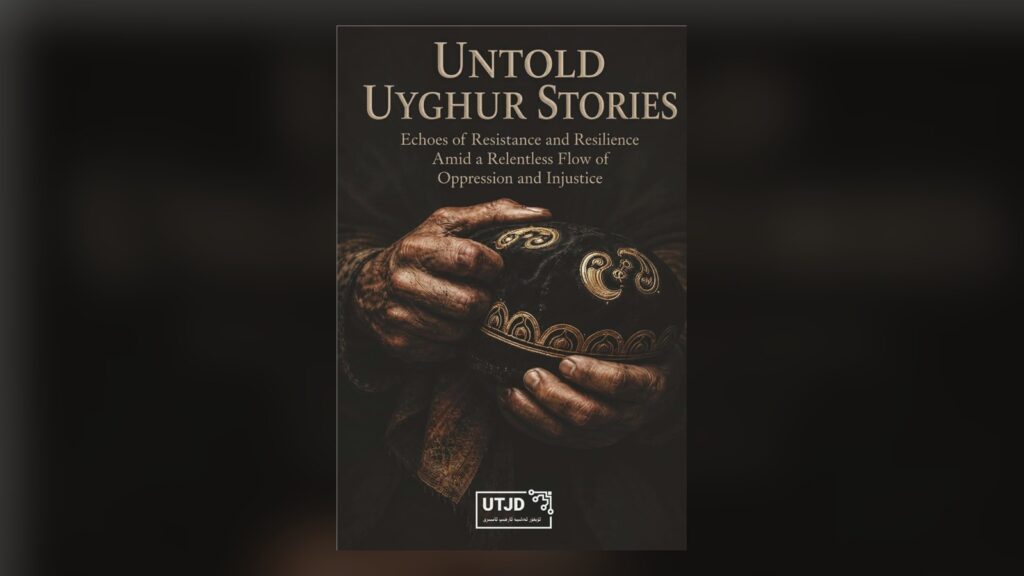
Book of 26 Uyghur testimonies launched at Washington conference on documenting abuses
WASHINGTON, D.C. A Norway-based documentation group launched the English edition of a book of 26 Uyghur testimonies at the National Endowment for Democracy on Oct. 28, where its founder said that personal accounts move readers in a way statistics cannot.
The book, Untold Uyghur Stories: Echoes of Resistance and Resilience Amid a Relentless Flow of Oppression and Injustice, was published by the Uyghur Transitional Justice Database in September, nine months after a Uyghur-language edition was launched in Istanbul. The English print edition runs 252 pages. Three contributors have testified publicly before. Gulbahar Haitiwaji, author of the memoir How I Survived a Chinese Re-Education Camp, and Qelbinur Sidik testified before the Uyghur Tribunal in London in 2021 and before the House Select Committee on the Chinese Communist Party in 2023. Gulbahar Jelilova testified before the tribunal in June 2021. Other contributors are not named, for their safety.
The conference, titled “The Big Picture: China’s Long-Term Policies of Cultural Erasure in the Uyghur Region,” was hosted by NED and moderated by William Nee, its senior program manager for East Asia, who framed the discussion around the tenth anniversary of Chen Quanguo’s appointment as the region’s party secretary. The panelists were Adiljan Abdurihim, director of the Uyghur Transitional Justice Database; Elise Anderson, director of the Transnational Repression Initiative at the New Lines Institute, a Washington think tank; and Alexander Boyd, associate editor of China Books Review. About 35 to 40 people attended, among them Lynn Lee, NED’s senior director for East Asia and strategic partnerships; Katrina Lantos Swett, president of the Lantos Foundation for Human Rights and Justice; and members of the Uyghur and Chinese diaspora. Közet attended.
Bahtiyar Omar, the database’s founder and executive director, said in an interview with Közet after the panel that the book was meant to draw international attention through firsthand accounts rather than numbers.
“Statistics do not seem to have much impact on people,” Omar said. “There is evidence that three million people were detained in camps, but that is just a statistic. It does not necessarily affect people emotionally. What affects people is the experience each individual has lived through.”
Independent estimates of the number of Uyghurs and other Turkic people detained since 2017 have ranged from several hundred thousand to more than one million, according to the Council on Foreign Relations and the U.S. Holocaust Memorial Museum; the U.S. State Department and members of Congress have cited the figure of more than one million. The Chinese government has never published a number. A 2022 assessment by the UN human rights office found that the detentions may constitute crimes against humanity.
Beijing has rejected those findings and describes the facilities as vocational education and training centers that formed part of counterterrorism and deradicalization measures. The Chinese Embassy in Washington did not respond to a request for comment.
Omar said each account concerns one person or one family but reflects experiences shared by millions across the region, which he called East Turkistan. From the stage, he urged attendees to use that name rather than Xinjiang, the Chinese government’s name for the region, which he said translates as “new frontier” and reflects a colonial claim. Many Uyghur organizations reject the Chinese name on those grounds; Beijing treats “East Turkistan” as a separatist term.
The testimonies were collected between October 2023 and May 2025 and recount events from the early 1950s to the present, with particular attention to the mass detentions that intensified from 2016. One contributor, Patigul Rozi, traces her family’s story from the Cultural Revolution to the detention of relatives from 2014 onward.
Nee said from the stage that the book adds new material on capital punishment, trials, household registration and the timing of crackdowns. “The book is so much more than just information,” he said. “It really provides perspectives and experiences and emotions of the Uyghur community and their lived testimonies.” One contributor, he said, had written that by putting the account on paper, “I can now die in peace.”
Abdurihim, speaking for the database, said the repression did not begin in 2014 but has run through the whole period of Chinese Communist rule, and that the testimonies bear witness to that longer history. He said the database has published three books, is translating this one into Russian, and plans Chinese and Turkish editions.
Anderson, a scholar of Uyghur music who lived in Urumqi, the capital of the Xinjiang Uyghur Autonomous Region in China’s far west, from 2012 to 2016, said from the stage that the accounts show how much remains unknown even to people who work on the issue. “There’s so much more underneath what we think we know,” she said.
She told Közet after the panel that the detail behind the numbers is what could move policymakers, and suggested one-on-one briefings with legislators and other decision makers. Testimonies would need to be combined with documentation and statistical evidence, she said, and “it’s going to take persistence in advocacy for everyone involved.”
Elfidar Iltebir, program director of the Uyghur Wellness Initiative, which provides mental-health support to Uyghurs in North America, said in an interview with Közet that readers are moved by individual stories rather than by statistics. “Major developments begin with the small stories of individual people,” she said.
The Uyghur Transitional Justice Database was founded in 2018 and registered as an independent organization in Norway in 2019. It documents detentions and collects testimonies from Uyghurs and other Turkic people. Omar said the database has been funded by grants from NED and the Open Technology Fund and by donations, and that the Uyghur-language edition was published with funding from the East Turkistan Research Center in Türkiye. That edition is distributed mainly through diaspora networks and centers in Istanbul; both editions are sold on Amazon.
Several speakers said international attention had faded. Omer Kanat of the Uyghur Human Rights Project said from the floor that no major international initiative on the issue had been taken since 2022, while Beijing had invited journalists and delegations to the region to promote its own account. UHRP and George Washington University will hold a conference in Washington on Dec. 9 and 10 to assess ten years of the campaign and the international response, he said.
Közet receives funding from the National Endowment for Democracy, which hosted the conference and has also funded the Uyghur Transitional Justice Database.