
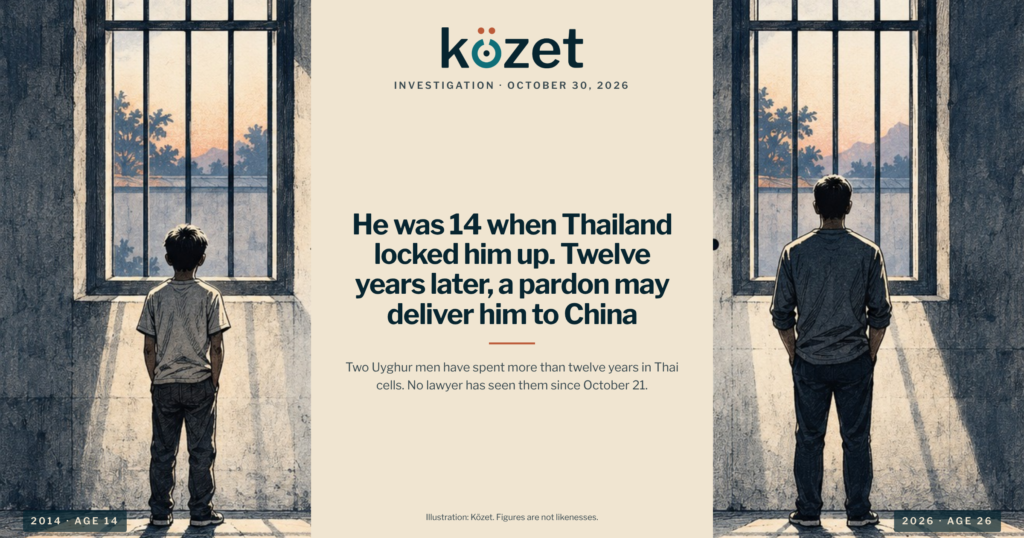
He was 14 when Thailand locked him up. Twelve years later, a pardon may deliver him to China
Two Uyghur men, one of them a boy at the time, were detained in Thailand in 2014 and have spent more than twelve years in Thai cells. Since their transfer to immigration custody, no lawyer has been allowed to see them. Six days after it, the Chinese ambassador met the official who will decide where they go next.
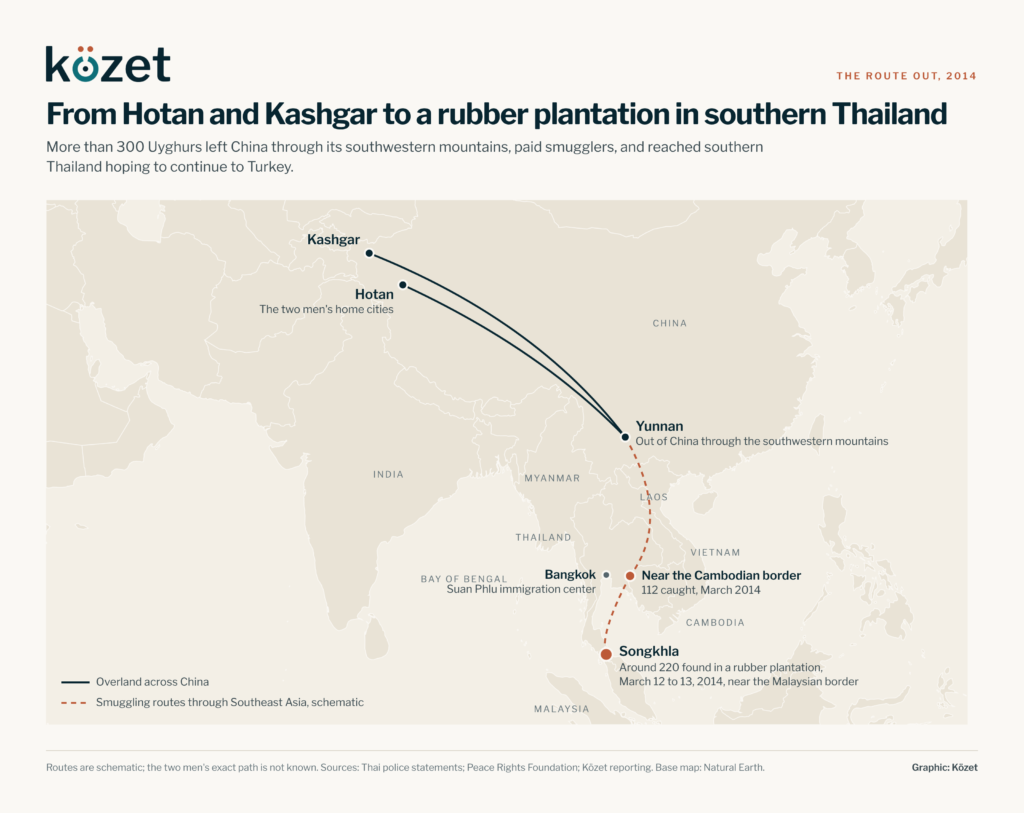
NEW YORK — The younger one was 14, by the account he later gave his lawyers, when Thai immigration police found him in a rubber plantation near the Malaysian border in March 2014. The older one was in his early twenties. They were two of more than 300 Uyghurs who had slipped out of China through its southwestern mountains, paid smugglers, and reached southern Thailand hoping to continue to Turkey.
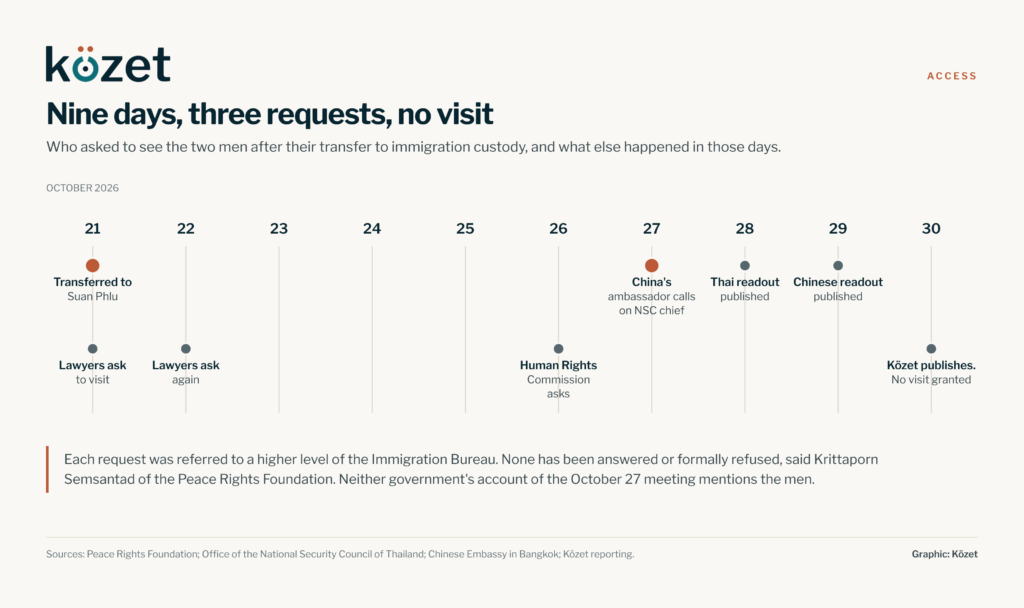
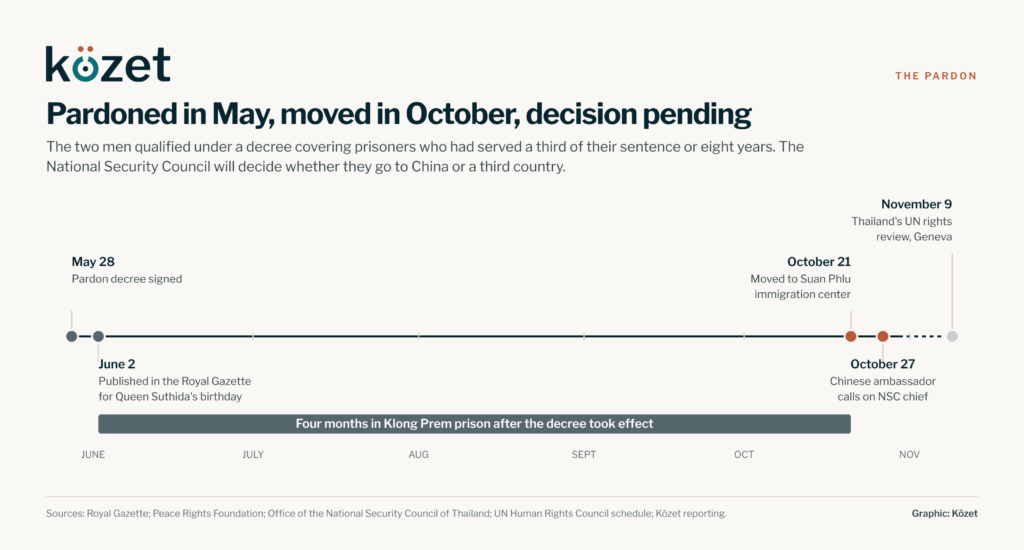
They never left. On October 21, after more than six years in Thai prisons and nearly five before that in immigration cells, the two men were transferred under a royal pardon to Bangkok’s Suan Phlu Immigration Detention Center, the same facility from which Thailand deported 40 other men from their group to China in February 2025. Thailand’s Immigration Bureau told AFP they will be sent to China or to a third country once the National Security Council decides.
Since then no one has been allowed to see them. Human rights lawyers and the Peace Rights Foundation, the Thai organization that represents them, asked to visit on October 21, the day of the transfer, and again on October 22; Thailand’s National Human Rights Commission asked on October 26. Each time, immigration officials referred the request to a higher level of the bureau, and none has been answered or formally refused, said Krittaporn Semsantad, the foundation’s program director. The commission was told to submit its request to the commander of the Immigration Bureau, a step she described as a way to divert and delay the decision.
“They have no access to their lawyer, human rights organizations, or their friends in Thailand, not even a phone call to their families in the diaspora,” said Nyrola Elimä, an independent researcher based in Sweden who has followed the men’s cases since 2022. “They are being held completely incommunicado, just like the 40 men.”
Six days after the transfer, on October 27, China’s ambassador to Thailand, Zhang Jianwei, paid a call on the council’s new secretary-general, Gen. Chaipruak Doungprapat, who took office on October 1. The council described it as a courtesy call on the occasion of his appointment and said the two discussed “law enforcement cooperation between Thailand and China,” among other topics. Neither government’s account mentions the two men. At least one country has offered to take them, a Foreign Ministry official told a parliamentary committee in September, according to Krittaporn. Both she and Nyrola said they believe deportation is now imminent.
Közet is not naming the men, for their safety. The younger is from Hotan and now 26, the older from Kashgar and 34, Krittaporn said. Both are Uyghur cities in China’s far northwest, where the UN human rights office concluded in 2022 that Beijing’s treatment of Uyghurs and other predominantly Muslim groups may amount to crimes against humanity. Nyrola, who reported on the group’s flight from China for The New York Times Magazine, has communicated with them only through fellow detainees and their lawyers. A leaked Chinese document she has reviewed records a birth date on the younger man’s identity card that would have made him 16 when detained. Some Uyghur families have registered birth dates that differ from the real ones, one reason being that China’s identity card has long been issued at 16. Közet could not reconcile the two dates.
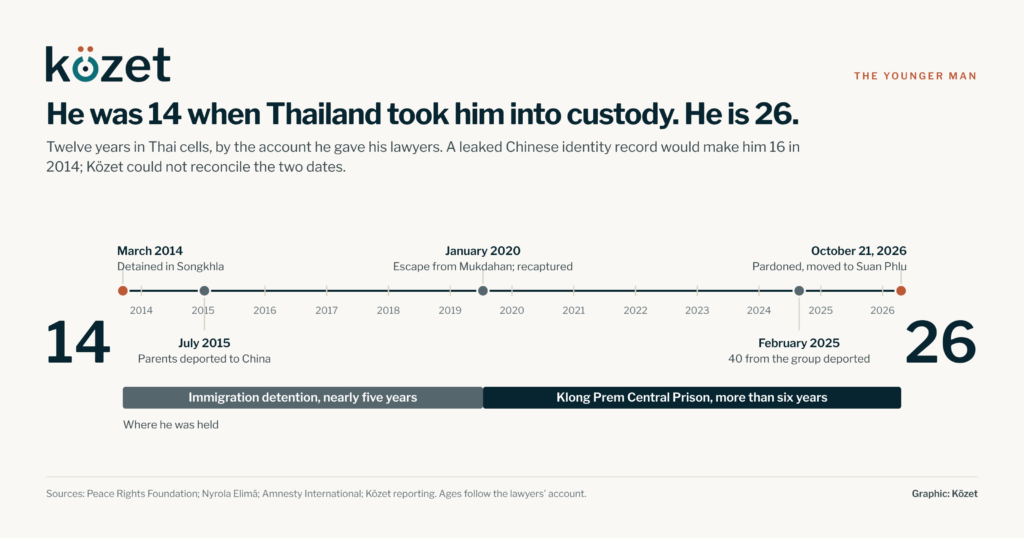
The younger man’s mother and father were among 109 Uyghurs that Thailand put on a Chinese charter flight on July 9, 2015. Nyrola said she learned this from a leaked document and from men who had shared a cell with him; Krittaporn said he had told the foundation the same, though it could not verify it. Chinese state television showed the deportees seated on the aircraft, hooded, with police beside them. The next day China’s Ministry of Public Security told the Global Times, a tabloid published by the Communist Party’s People’s Daily, that the returnees included criminal suspects, people “involved in terrorist activities” and “quite a few who were coerced into leaving,” and that those not prosecuted would be “properly resettled” after “education and transformation.” Their families abroad have not heard from any of them since.
Both men have told their lawyers they fled because of constant surveillance and unannounced visits by the authorities, Krittaporn said, and both fear being charged with fabricated crimes if returned; their relatives, they said, had already been subjected to false charges.
They have already said, in writing, that they do not want to go back. Over their years in Klong Prem Central Prison they wrote letters to the visitors on their approved list saying they did not want to return to China, Krittaporn said; the foundation holds a compilation of them. In January 2025, when the 43 Uyghurs then at Suan Phlu refused to sign consent forms for return to China and issued a handwritten appeal, the five men then in prison, these two among them, joined in a letter asking to be resettled in a third country, Nyrola said. “My understanding is that they do not want to be returned to China because they fear what will happen to them there.”
At the lawyers’ last prison visit before the transfer, Krittaporn said, they told the men to sign nothing without legal advice. Whether anything has been put in front of them since, she does not know. The men are eligible neither for UNHCR’s refugee status procedure nor for Thailand’s national screening mechanism, she said. The Immigration Bureau did not respond to Közet’s questions.
The same pattern
The two men qualified for the pardon under a decree signed on May 28 and published in the Royal Gazette on June 2, marking Queen Suthida’s birthday; it covered prisoners who had served at least a third of their sentence or eight years. They were not moved for four months.
The council’s Facebook post on the October 27 meeting, published the following day in Thai and English and reviewed by Közet, lists law enforcement cooperation first among the subjects discussed, “among others.” The Chinese embassy’s account, published two days later, says Zhang praised the two countries’ “good cooperation in judicial and law-enforcement affairs” and quotes Chaipruak pledging to strengthen “all-round cooperation” with China. Law enforcement cooperation is the language Beijing used last time: when it announced the return of the 40, its embassy in Bangkok called it “a concrete measure between China and Thailand in collaboratively tackling immigration crimes.” The council’s correspondence and public relations unit acknowledged receipt of Közet’s questions but had not answered them by publication. The Chinese embassy did not respond.
Nyrola sees a pattern in the timing. In 2025, China’s formal request for the 40 men was followed the next day by consent forms put in front of them, and the council’s closed-door decision by weeks of public denials, before the men were flown out on February 27.
“I can’t confirm what was said in that meeting,” she said of the October 27 call. “But the timing follows a pattern we’ve seen before, and that alone is cause for serious concern.” Krittaporn, asked whether she shared that view, cited what she called China’s recent gesture and its record in the 2025 case.
Thailand’s own National Human Rights Commission found that deportation unlawful. In findings announced last November, it said the government, the National Security Council and the Immigration Bureau had violated the principle of non-refoulement, which bars returning people to a country where they face persecution, and Thailand’s 2022 anti-torture law. The government, it found, relied solely on a verbal Chinese assurance, and its claim that the men went voluntarily was unsupported. The commission urged the council to reconsider deporting the five Uyghur men then still in prison, and said any future return must be voluntary, publicly disclosed, and backed by a verifiable Chinese guarantee. Two of those five are the men now at Suan Phlu. The commission’s office acknowledged receipt of Közet’s questions but had not answered them by publication.
Twelve years in the system
The Songkhla raid on March 12–13, 2014 netted around 220 people hiding in a plantation in Rattaphum district who told police they were Turkish. Another 112 were caught near the Cambodian border the same month. Thai authorities split the families: women and children to a social-welfare shelter, men and older boys to immigration detention.
Most of the women and children, 173 by Thai count, were flown to Turkey at the end of June 2015; Turkey had offered to take all of them. A week later Thailand sent the 109 to China. Fifty-three were left behind in Thai immigration cells, among them the teenager from Hotan and the young man from Kashgar.
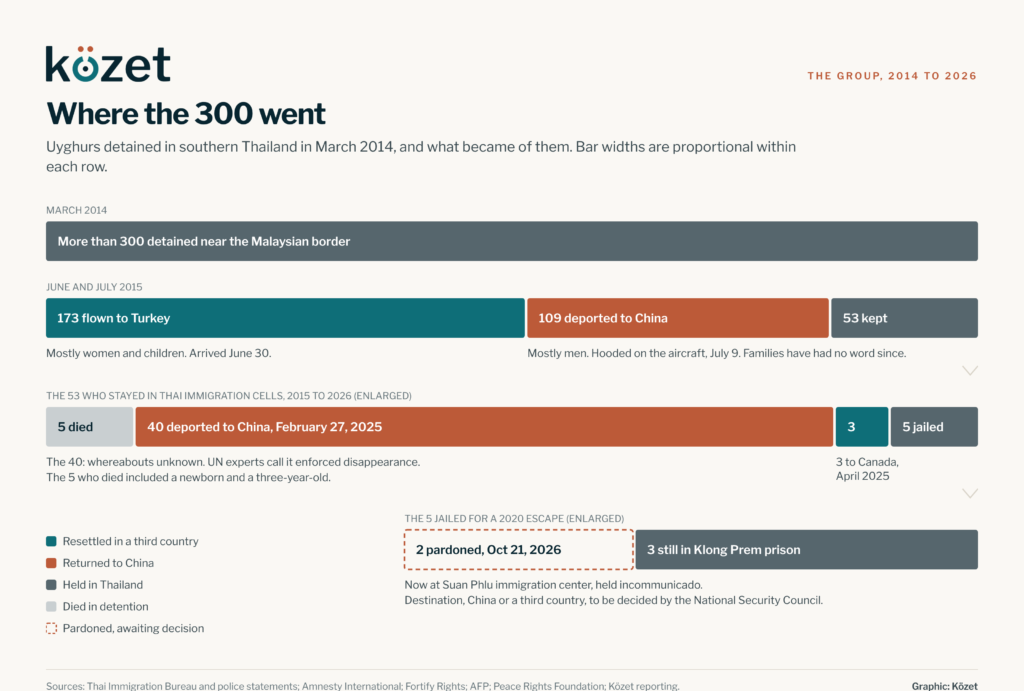
Over the following years five of the group died in detention, including a newborn and a three-year-old. The survivors were moved between provincial immigration offices and barred from phones, lawyers and family, singled out for stricter treatment because the council had classified their case as a matter of national security. In Mukdahan, on the Lao border, they were held in a cell where, a Thai rights advocate who visited them told BenarNews, they did not see the sun or the moon for nearly four years. A Thai cook who worked at the center later told Global Voices that Uyghur detainees there were denied medical care and that at least one had been beaten badly by officers.
On January 10, 2020, seven of the Uyghurs held at Mukdahan escaped. All were recaptured within three days. The prison that received the older of the two men documented injuries he had sustained between leaving the immigration facility and arriving in police custody, Krittaporn said; she has seen the record, which does not say who inflicted them.
A Mukdahan court gave the seven two years for the jailbreak, damaging state property and intimidating officials. Five, including the two men, were also charged with robbery for taking a gun from a Thai man during their flight, and were sent to Klong Prem with sentences running to 2029. The two who were not charged with robbery finished their sentences, returned to immigration detention, and were among the 40 deported last year. Amnesty International took up the five men’s case and said two of them had been 16 when first detained.
Neither man showed health problems when the lawyers visited them in prison, Krittaporn said. No one outside the detention center has been able to assess their condition since the transfer.
What happened to the 40
Thai officials began discussing deportation as early as December 2024, a month after Prime Minister Paetongtarn Shinawatra met Xi Jinping on the sidelines of the APEC summit in Lima, according to testimony to a parliamentary inquiry reported by the Associated Press. On January 8, 2025, China sent Thailand a formal request for the men’s return. The same day, immigration officers asked the 43 Uyghurs at Suan Phlu to sign papers agreeing to return to China. They refused and were photographed one by one. On January 15 China’s embassy said the men were Uyghur separatists.
The men went on hunger strike on January 10 and stopped on January 29 after Thai officials assured them they would not be sent back. In late February, representatives of Thailand’s Sheikhul Islam office, the country’s highest Islamic authority, visited and repeated that assurance.
On January 17 the National Security Council, meeting behind closed doors with the defense and justice ministers present, had already decided to deport them, its secretary-general later told a parliamentary inquiry. That same day the defense minister told reporters there was no plan to do so. The council’s chief at the time, Chatchai Bangchuad, said the decision rested partly on Chinese commitments that the men would be treated well and that Thai officials could visit them.
On February 14, Nyrola testified at the South Bangkok Criminal Court in a petition challenging the men’s detention. On February 18 the court found the petition had merit and ordered the head of the Immigration Bureau, or a representative, to appear for questioning on March 27. The deportation came first.
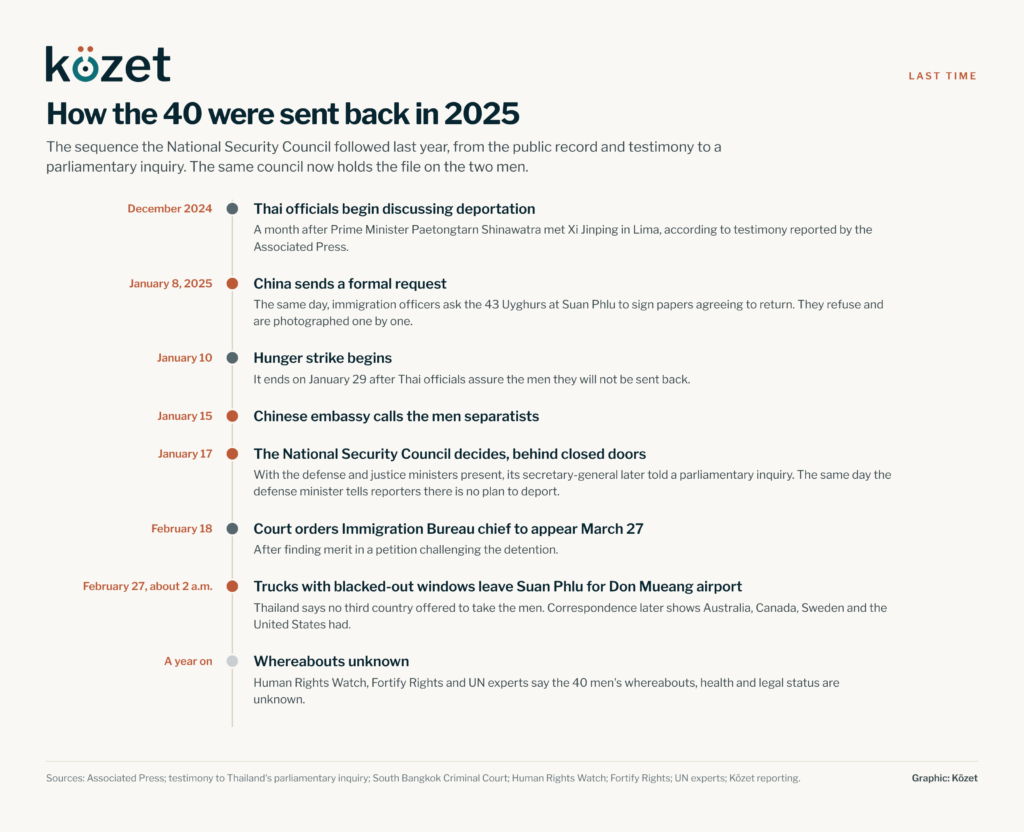
At around 2 a.m. on February 27, trucks with blacked-out windows left Suan Phlu for Don Mueang airport. Thailand said no third country had offered to take the men. Kannavee Suebsang, then an MP, produced correspondence showing that Australia, Canada, Sweden and the United States had, and the U.S. State Department confirmed it had offered repeatedly.
Chatchai flew to China two days later to be photographed with deportees’ families; ministers followed on March 19. The visits stopped by mid-year. A year on, Human Rights Watch, Fortify Rights and a group of UN experts said the 40 men’s whereabouts, health and legal status were unknown, that families had received no word, and that China’s silence amounted to enforced disappearance. The United States restricted visas for the Thai officials involved. The European Parliament condemned the deportation. Thailand, newly seated on the UN Human Rights Council, said it had received assurances from China.
The same council now holds the file on these two.
“The decision that needs to be made”
Kannavee, who was working for the UN refugee agency when the group was arrested in 2014, told AFP last week that the council “will have to consider different factors. For example, if another country is offering to host these men as well as China.” He did not respond to Közet’s questions.
The offer the lawyers describe came on September 16, when a Foreign Ministry representative told the parliamentary Committee on Foreign Affairs, at a hearing where the Peace Rights Foundation appeared as a complainant, that one country had extended an offer to take the men and that China had also reached out, Krittaporn said. Közet has not seen a record of the hearing. Thai officials have given the lawyers no timeline, she said. Her own expectation is that nothing will be decided before Thailand’s human rights record is reviewed at the UN in Geneva on November 9, or before an expected visit to Thailand by China’s premier, Li Qiang, who accepted an invitation from Bangkok last year.
Canada resettled three of the group in April 2025. The two men applied to UNHCR for refugee status years ago and “never got any refugee certificate or any visit,” Nyrola said. Krittaporn declined to discuss the agency’s handling of their cases. UNHCR has never publicly said whether it processed the group’s applications. In 2024 its spokesperson, Babar Baloch, told Voice of America that “at no stage have we been permitted to access the group or engage with them for the purpose of facilitating solutions.” The agency did not respond to Közet’s questions. Internal UNHCR documents reported by The New Humanitarian show that in 2020 the agency’s Thailand office declined to act on Thai overtures to help resolve the group’s detention, citing the risk to its operations and funding in China.
Three men from the group remain in Klong Prem. Krittaporn declined to discuss their cases, citing concern for their safety while they are still in prison.
The younger man was 14 when Thailand took him into custody. He is 26. He has spent nearly half his life in Thai cells.
Közet sent written questions to the Office of the National Security Council, the Chinese Embassy in Bangkok, the Immigration Bureau, UNHCR and the National Human Rights Commission of Thailand. The National Security Council and the commission acknowledged receipt of the questions; neither had answered by publication. The Chinese embassy, the Immigration Bureau and UNHCR did not respond.